input power
Arduino Uno R3
- 9 V can feed a documented Uno VIN/barrel route if connector/polarity and regulator load are appropriate.
Connection conditions
- Never feed 9 V into 5 V or GPIO; regulator heating depends on load.
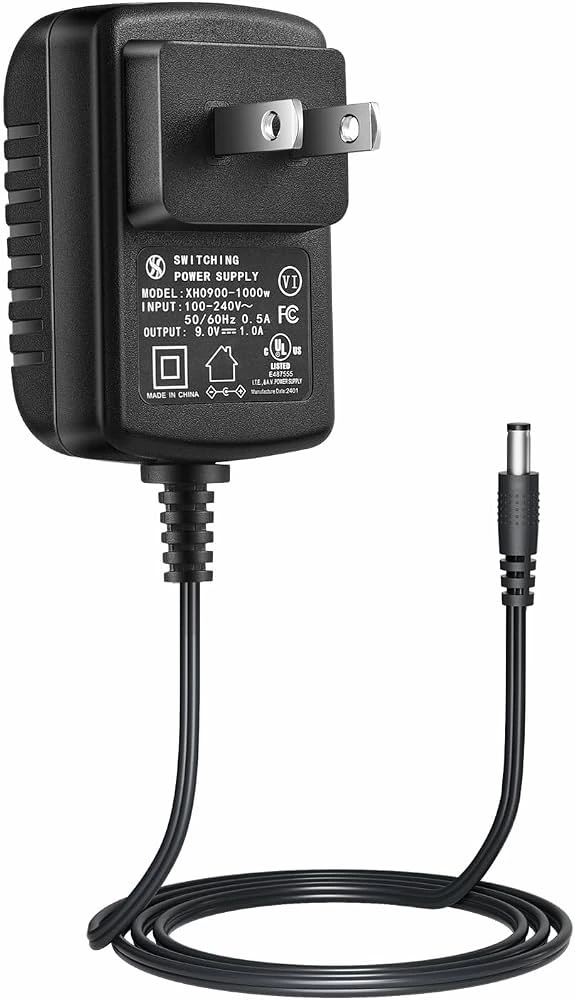
Power
A source-listed 9 V, 1 A DC adapter supplies a compatible device’s power input; it is not a 5 V logic rail.
DC barrel output
Provides a mains-powered DC source for hardware with an appropriate regulator/input connector. The current rating describes available output capability, not a current it forces through every load.
Internal conversion and regulation turn AC input into DC output; exact topology and regulation behavior are not established. Load current follows the connected circuit, while voltage must match the device input requirement.
Plug-in adapter with DC barrel cable and 9 V/1 A label. Read polarity symbol and barrel dimensions.
Also called: 9v 1a adapter, piece of 9V 1A power supply
Match voltage, center polarity and plug size to the intended input, then verify DC output with a meter. Use a board’s documented barrel/VIN route only if compatible; never connect 9 V directly to a 5 V or 3.3 V pin.
Read the conditions before connecting parts. A relationship can involve a driver, controller or a redesigned circuit.
input power
power conversion
power verification
Quantity: 2 · quantity confidence: high
Known countable purchase/BOM contributions. Each source line is a total; do not multiply by container count or add photo observations.
Ownership: source-backed club holding. Identity confidence: high.
Identity follows exact kit sheet/BOM; expected quantity is not a physical stocktake.
V1 establishes the catalog identity. Technical references explain the named device or component class; unverified carrier-specific ratings and pinouts are not asserted.
Original V3 image confidence: 90% · high. Component crop tied to an owned kit and its source mapping; selected by form rather than filename alone.
Original V3 image source: ELEGOO Mega reference (owned kit reference). Images describe identity and form; they do not establish quantity.
Displayed image source: User-supplied 9v-1a-adapter reference image attached in chat.
User-selected DC adapter reference visibly states 9.0 V 1.0 A. Full supply housing, mains prongs, cable loop, barrel plug and physical markings retained. Exact owned polarity, connector dimensions, safety certification and performance remain unverified.
User-supplied reference image; original rights retained.