Labs / PiCrawler
PiCrawler
Learn to connect to the club's walking robot, check its Python environment and prepare one supervised experiment.
Start here
Open Start Here →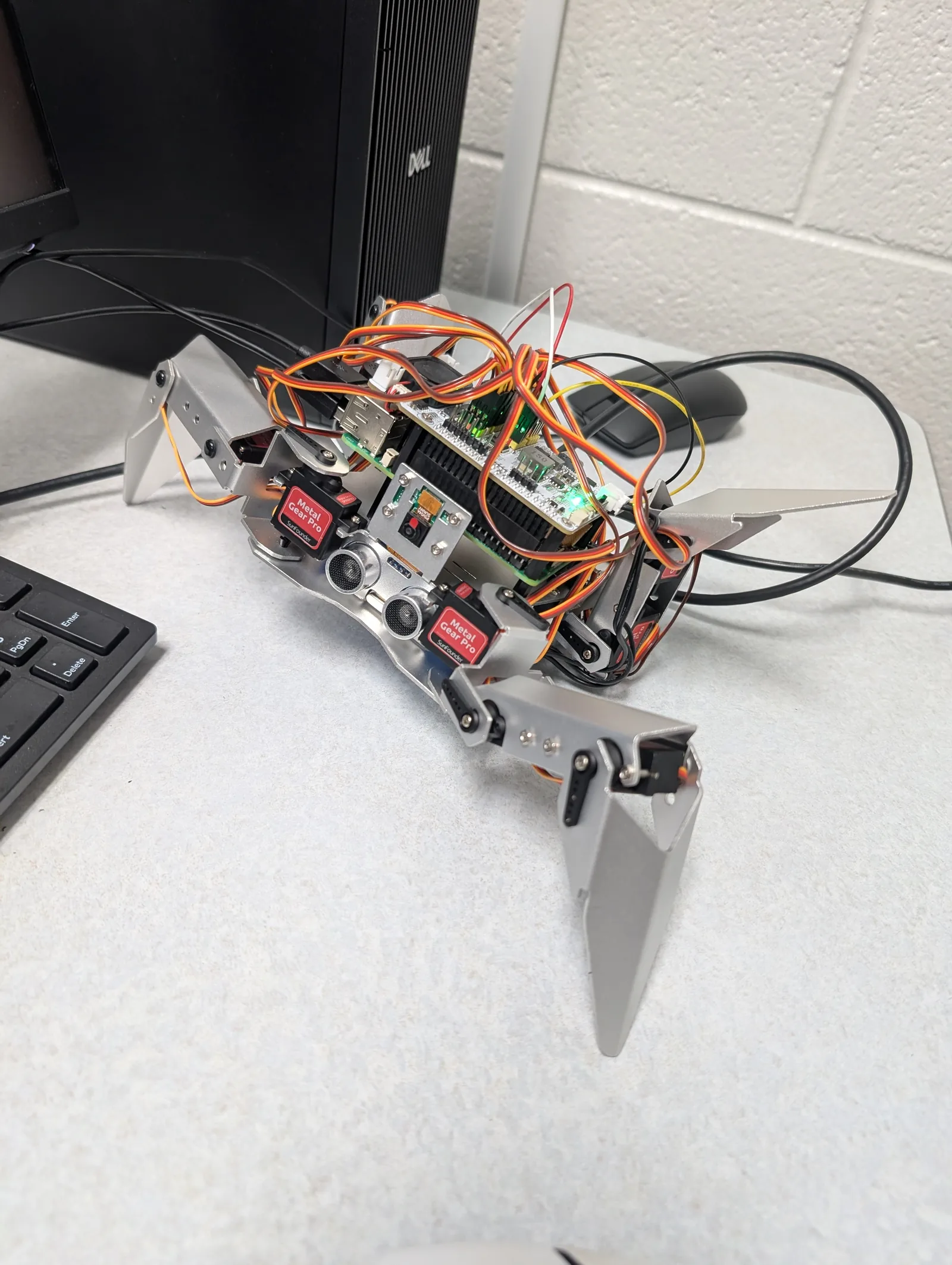
Go further
- ProgrammingEdit on Windows through VS Code Remote SSH; run Python on the Pi.
- Source/API lookupFind a function, its exact source and its side effects.
- Projects & ExperimentsExplore proposals to develop after recovery and qualification.
- Technical ReferenceLook up detailed API research, limitations and remaining questions.
Robot details, engineering reference & club history
SunFounder PiCrawler CN0488D · Raspberry Pi 5 / 4 GB · twelve servos, camera, ultrasonic ranger and speaker.
Robot HAT V4 — visually confirmed by club owner. Reported 2026-10-25. The dated specifications below record later installation checks and observed servo motion. Calibration, standing and walking are not yet established.
- Hardware & Servos
- Architecture & Command Safety
- Movement, Frames & Inverse Kinematics
- Calibration & Configuration
- Sensors & Range
- Camera & Vision
- Audio, Voice & AI
- Networking & Remote Development
- What Can It Do?
- Modification Atlas
- Engineering Experiments
- Upgrades & Distributed Robotics
- Recovery & SD-card Preservation
- Troubleshooting & Diagnostics
Historical PiCrawler project log records actual club activity. The experiment catalog contains proposals.
Technical specifications
SunFounder PiCrawler · Engineering Club ·
| Component | Model / Specifications |
|---|---|
| Computer | Raspberry Pi 5 Model B Rev 1.1 · 4 GB RAM · 64-bit ARM |
| Control board | SunFounder Robot HAT V4 |
| Microcontroller interface | I²C bus 1 · Address 0x14 · Communication tested |
| Servos | 12 × SunFounder Metal Gear Pro servos · 3 per leg · Exact model and torque not yet identified |
| Mechanical structure | Four-legged aluminum-alloy quadruped · 12 actuated joints |
| Camera | OmniVision OV5647 · 5 MP · CSI interface · 2592 × 1944 maximum resolution |
| Ultrasonic sensor | HC-SR04-type · 40 kHz · Nominal 2–400 cm range · Exact model unverified |
| Speaker | Robot HAT V4 onboard mono I²S audio · Published speaker specification: 8 Ω / 1 W |
| USB audio | Texas Instruments PCM2902 USB audio codec · Detected |
| Battery | Lithium-ion · 7.4 V · 2,000 mAh · 14.8 Wh · Label verified |
| Charging | Robot HAT V4 USB-C charging circuit |
| Battery input | 6.0–8.4 V · 3-pin XH2.54 connection specified by SunFounder |
| Servo PWM outputs | 12 channels · P0–P11 |
| Additional HAT interfaces | 4 analog inputs · 4 digital I/O · I²C · SPI · UART · 2 DC motor channels |
| Storage | Approximately 32 GB microSD card · 29 GB root partition |
| Operating system | Debian GNU/Linux 13 (Trixie) · Linux 6.12.75 |
| Programming | Python 3.13.5 · VS Code Remote-SSH |
| Core libraries | PiCrawler 2.1.4 · Robot HAT 2.3.6 · Vilib 0.3.18 |
| Computer vision | Picamera2 0.3.34 · OpenCV 4.10.0 |
| Current status | SSH operational · Camera detected · Robot HAT detected · Initial servo movement observed · Calibration not completed · Walking untested |
| Specification | Value |
|---|---|
| Battery type | Rechargeable lithium-ion |
| Cell configuration | 2 cells in series (2S), expected |
| Nominal voltage | 7.4 V |
| Fully charged voltage | 8.4 V, expected |
| Pack capacity | 2,000 mAh |
| Energy capacity | 14.8 Wh |
| Connector | XH2.54 3-pin, manufacturer specification |
| Listed weight | 90.8 g, manufacturer specification |
| Charging | Robot HAT V4 USB-C charging circuit |
| Verification | Actual battery label photographed |
The HAT interface values are published capabilities, not a claim that every interface has been functionally tested. The battery’s 7.4 V and 2,000 mAh are confirmed by its photograph; its cell configuration, connector and listed weight retain their manufacturer-based qualifications.