Two compatible AA cells with chosen chemistry and adequate current capability
The holder has no energy source by itself.
Power
A two-AA-cell holder mechanically retains cells and normally combines their voltages in series for a small battery supply.
Battery contacts; two power leads
Provides a portable power connection without soldering to cells. Output depends on chemistry, state of charge and series wiring; the empty holder is not a regulated supply or charger.
Spring/plate contacts join cell terminals. In a series holder the voltages add, while current passes through each cell; polarity reversals or mismatched cells can create stress rather than useful voltage.
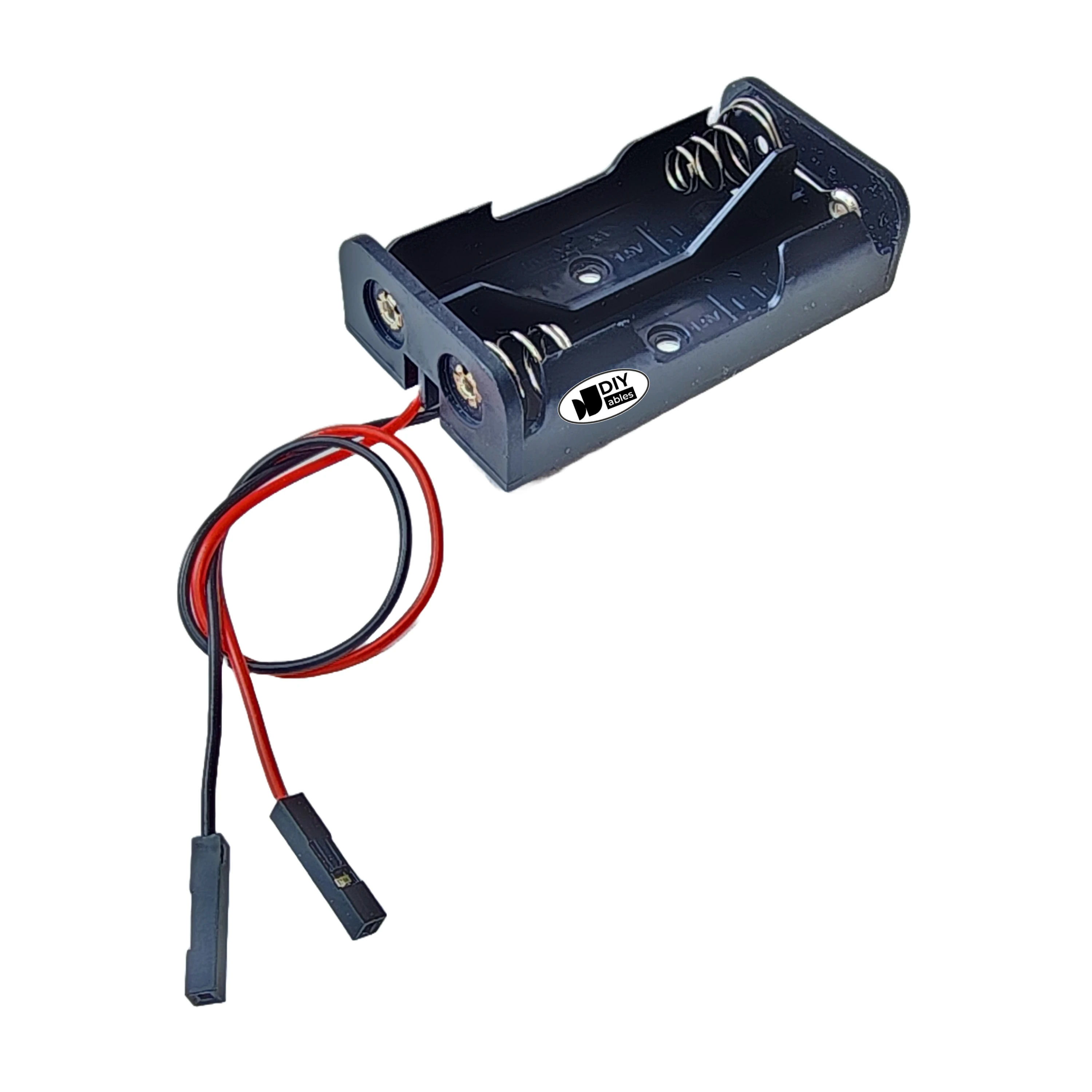
Black two-cell body with polarity symbols, springs and red/black leads.
Also called: 2x aa battery holder
Verify contact topology/polarity, insert matched compatible cells in the marked direction and measure the assembled output under load. Use a regulator if the circuit requires a fixed rail. Remove cells for storage when leakage is a concern.
The holder has no energy source by itself.
Read the conditions before connecting parts. A relationship can involve a driver, controller or a redesigned circuit.
battery characterization
Quantity: 1 · quantity confidence: high
Known countable purchase/BOM contributions. Each source line is a total; do not multiply by container count or add photo observations.
Ownership: source-backed club holding. Identity confidence: high.
Identity follows exact kit sheet/BOM; expected quantity is not a physical stocktake.
V1 establishes the catalog identity. Technical references explain the named device or component class; unverified carrier-specific ratings and pinouts are not asserted.
Original V3 image confidence: 90% · high. Component crop tied to an owned kit and its source mapping; selected by form rather than filename alone.
Original V3 image source: Freenove FNK0020 older sheet (owned kit reference). Images describe identity and form; they do not establish quantity.
Displayed image source: User-supplied Two-AA-cell battery holder reference photograph.
Two-cell AA holder with attached leads; connector appearance does not establish polarity or compatibility.
User-supplied reference image; original rights retained.