intermediate
Eight LED states from three control signals
Core electronics availableShift an eight-bit pattern, latch it and observe why visible outputs remain stable during the next transfer.
Discrete Components
100 nF nonpolar ceramic capacitor stores electric-field energy. Local IC decoupling and short high-frequency supply disturbances are appropriate uses when voltage and circuit requirements are checked.
Two-terminal passive
Local IC decoupling and short high-frequency supply disturbances rely on charging and discharging this capacitance. 100 nF placed close to an IC provides a short local path for fast current changes; long leads reduce its effectiveness.
Separated conductive surfaces accumulate opposite charge across a dielectric. Current flows while voltage changes, i = C dV/dt; stored energy is ½CV². Real capacitors also have leakage, series resistance and lead inductance.
Ceramics use a solid dielectric; aluminum electrolytics typically use etched foil, an oxide dielectric and electrolyte to achieve higher capacitance in a small can.
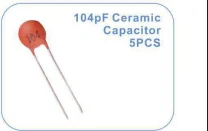
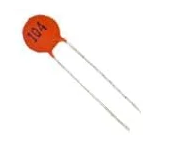
Small non-polar disc, often marked 104; 104 means 100 nF, not 104 pF. Read the value and rating rather than estimating from body size.
Also called: capacitor 0 1uf, 104pf ceramic capacitor, pieces of 100NF ceramic capacitors
Place across an IC supply and ground with short leads for decoupling; for timing use the circuit design values. No polarity is required.
intermediate
Shift an eight-bit pattern, latch it and observe why visible outputs remain stable during the next transfer.
intermediate
Control a small brushed motor while measuring driver voltage loss and startup behavior.
Read the conditions before connecting parts. A relationship can involve a driver, controller or a redesigned circuit.
support hardware
support hardware
signal conditioning
rc timing
supply decoupling
rc prototyping
Quantity: 12 · quantity confidence: high
Known countable purchase/BOM contributions. Each source line is a total; do not multiply by container count or add photo observations.
Ownership: source-backed club holding. Identity confidence: high.
Identity follows exact kit sheet/BOM; expected quantity is not a physical stocktake.
V1 establishes the catalog identity. Technical references explain the named device or component class; unverified carrier-specific ratings and pinouts are not asserted.
Original V3 image confidence: 90% · high. Component crop tied to an owned kit and its source mapping; selected by form rather than filename alone.
Original V3 image source: Freenove FNK0020 older sheet (owned kit reference). Images describe identity and form; they do not establish quantity.
Displayed image source: Freenove FNK0020 older sheet; user-approved V2 image cleanup.
User explicitly authorized integration of approved entries from the supplied V2 decisions export. Exact reviewed candidate bytes retained; original inventory identity, confidence and hardware facts remain unchanged.
Original reference image rights retained; cleanup does not change attribution or license.