What it does
Bulk buffering and slow RC filtering rely on charging and discharging this capacitance. A larger value changes voltage more slowly during a brief current demand: ΔV ≈ IΔt/C. It cannot compensate for an indefinitely undersized supply.
Useful specifications
- Capacitance
- 10 µF
- Polarity
- Polarized electrolytic
- Rated voltage
- 50 V
How it works
Separated conductive surfaces accumulate opposite charge across a dielectric. Current flows while voltage changes, i = C dV/dt; stored energy is ½CV². Real capacitors also have leakage, series resistance and lead inductance.
Ceramics use a solid dielectric; aluminum electrolytics typically use etched foil, an oxide dielectric and electrolyte to achieve higher capacitance in a small can.
Recognize the part
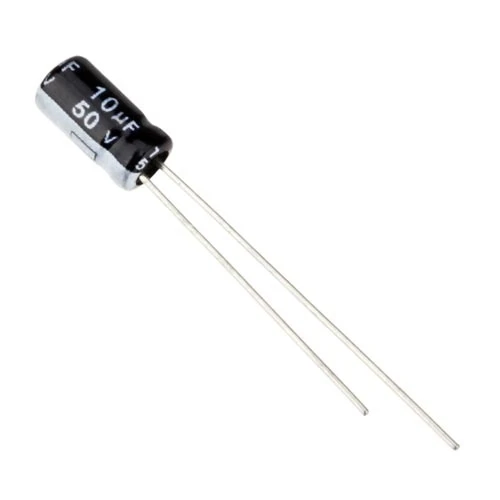
Cylindrical can marked 10 µF / 50 V with negative stripe. Read the value and rating rather than estimating from body size.
Also called: electrolytic capacitor 10uf 50v
How to use it
Connect the negative-striped terminal to the lower-potential node and the positive terminal to the higher one. Use a working voltage below the marked rating; discharge before resistance measurements.
Know before using
Limits
- Tolerance and parasitic resistance/inductance limit ideal behavior.
Common mistakes
- Confusing pF, nF and µF.
- Reversing the negative stripe.
- Treating 50 V as a required supply rather than a maximum rating.
Care and safety
- Reverse bias or overvoltage can heat, vent or rupture electrolytics.
Related owned hardware
Read the conditions before connecting parts. A relationship can involve a driver, controller or a redesigned circuit.
supply decoupling
- This capacitance can stabilize a low-voltage prototype rail against short bulk-current disturbances.
Connection conditions
- Read rated voltage; observe electrolytic polarity. A capacitor does not supply sustained motor current.
rc prototyping
- Together with a measured resistor, this capacitor makes charge/decay observable in a breadboard circuit.
Connection conditions
- Keep voltage below rating and account for input impedance, tolerance and leakage.
Inventory record and image evidence
Quantity: 2 · quantity confidence: high
Known countable purchase/BOM contributions. Each source line is a total; do not multiply by container count or add photo observations.
Ownership: source-backed club holding. Identity confidence: high.
Identity follows exact kit sheet/BOM; expected quantity is not a physical stocktake.
V1 establishes the catalog identity. Technical references explain the named device or component class; unverified carrier-specific ratings and pinouts are not asserted.
Source holdings
Parent kits
Original V3 image confidence: 90% · high. Component crop tied to an owned kit and its source mapping; selected by form rather than filename alone.
Original V3 image source: ELEGOO Mega reference (owned kit reference). Images describe identity and form; they do not establish quantity.
Displayed image source: User-supplied capacitor-10uf-50v reference image attached in chat.
User-selected radial electrolytic capacitor reference bears 10 uF and 50 V physical markings; both full leads retained. It does not establish the exact owned brand, tolerance or condition.
User-supplied reference image; original rights retained.