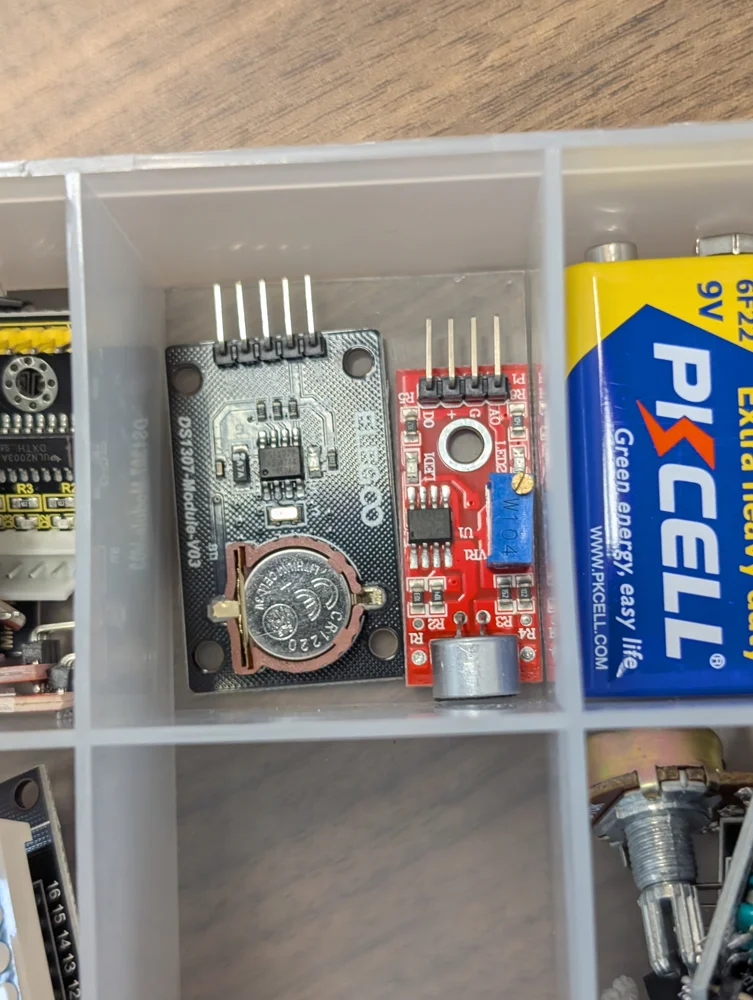
Site Guide

Find your way around the Engineering Club.

Know what you need? Search for a component, concept or project.

Around the site

Start

Labs

TestingExperimental

Build

Club

LearnExperimental

Go a little deeper

Entry points to larger collections. Use Search for individual records.

Learning paths & reference

Inside PiCrawlerExperimental

Inside Inventory

← Club inventory
DS1307 real-time clock module

Sensors

DS1307 real-time clock module

DS1307 keeps calendar time with a watch crystal and backup supply while the main controller is off.

Owned by clubQuantity: 1

I2C · I²C

What it does

Stores seconds, minutes, hours and calendar fields for timestamps or schedules. A backup cell maintains the oscillator, but the clock must first be set; it does not obtain correct time from a network automatically.

Useful specifications

IC main supply
4.5–5.5 V
Interface
I²C at 0x68
Oscillator
32.768 kHz crystal
Backup-cell/charging arrangement
Carrier-dependent; inspect board
How it works

A crystal oscillator supplies periodic ticks. Divider/counter registers track calendar time, typically as binary-coded decimal. The chip switches to a backup supply when main power falls; accuracy follows crystal loading, temperature and board design.

Recognize the part

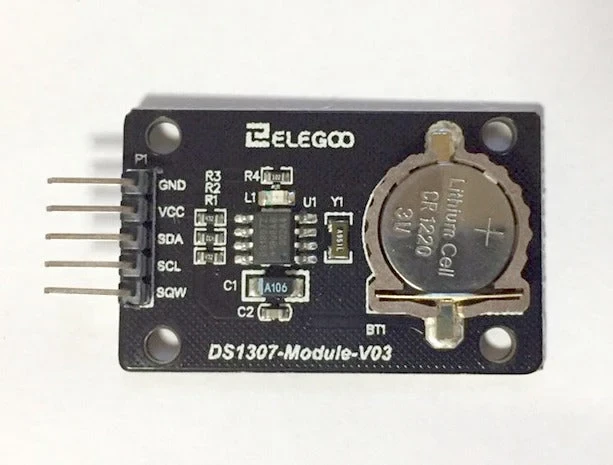
PCB with DS1307 IC marking, watch crystal and coin-cell holder; verify the actual carrier and battery arrangement. Read the IC; a coin-cell holder alone does not identify the clock.

Also called: DS1307 RTC, ds3231 rtc module

How to use it

Use I²C, inspect SDA/SCL pull-up voltage and read/write address 0x68. The DS1307 uses a 5 V main supply; do not transfer 3.3 V RTC-chip assumptions. Set clock/date with the correct library, verify running state, and inspect any charging circuit before installing a backup battery. Never charge a nonrechargeable coin cell.

Know before using

Limits

  • No temperature-compensated precision promised.
  • Wrong initial time remains wrong through backup.

Common mistakes

  • Using the other RTC model’s library.
  • Ignoring oscillator stop/write-protect settings.
  • Installing CR2032 into a carrier that charges its battery.

Care and safety

  • Identify charging paths and battery type before applying main power.

What you need with it

required

Arduino Uno R3

A device-specific host reads registers/conversions and interprets them.

  • Check the carrier supply, address and pull-up rail. Use one compatible pull-up network for the bus and avoid pulling 3.3 V GPIO to 5 V.
  • DS1307 is a 5 V-class RTC; backup cells and charger circuits must be checked.
Owned type; verify quantity, rating and fit for this use.

What can I build?

Related owned hardware

Read the conditions before connecting parts. A relationship can involve a driver, controller or a redesigned circuit.

i2c timekeeping

Arduino Uno R3

  • Uno can request and decode calendar/time registers with a device-specific library.
  • This module supplies calendar/time registers for an Uno logger or instrument.

Connection conditions

  • Check the carrier supply, address and pull-up rail. Use one compatible pull-up network for the bus and avoid pulling 3.3 V GPIO to 5 V.
  • DS1307 is a 5 V-class RTC; backup cells and charger circuits must be checked.

local display

2.42-inch SSD1309 128×64 OLED Display Module (I²C)

  • A controller can render calendar/time registers as a readable status or trend.

Connection conditions

  • Check the carrier supply, address and pull-up rail. Use one compatible pull-up network for the bus and avoid pulling 3.3 V GPIO to 5 V.
  • Display updates are separate from sensor/RTC acquisition.

When would I use each?

Clock Modules

Calendar/timekeeping role with bus, backup and driver changes.

Choose based on the existing host bus and library. Changing RTC requires rewiring and driver changes. Neither becomes a temperature-compensated clock solely because a different library displays seconds.

If you outgrow it

Researched external products, separate from club inventory. Price and availability are not promised.

Analog Devices

DS3231

Not owned by club

The logger needs lower temperature-related clock drift than a simple uncompensated RTC subsystem.

What improves

  • Improves timekeeping stability through an integrated temperature-compensated oscillator and crystal.
  • I²C time/calendar access supports a lower-drift logger clock.

The logger needs lower temperature-related clock drift than a simple uncompensated RTC subsystem. Choose this path only when the stated improvement is a requirement.

Tradeoffs

  • DS1302’s three-wire bus requires different wiring/software.
  • Breakout battery charging and pull-up rails vary; a compensated clock is not network/GNSS synchronization.

Additional hardware

  • Verified DS3231 carrier, correctly supported backup cell and I²C-compatible supply/signals
Migration steps
  • Review the exact product documentation and chosen carrier before purchase.
  • Rework connections, firmware/library configuration, power and mechanics as required by this path.
  • Validate the new subsystem against the project measurement or timing requirement.

Official product / documentation ↗
Documentation

Inventory record and image evidence

Quantity: 1 · quantity confidence: high

Known countable purchase/BOM contributions. Each source line is a total; do not multiply by container count or add photo observations.

Ownership: source-backed club holding. Identity confidence: high.

Identity follows exact kit sheet/BOM; expected quantity is not a physical stocktake.

V1 establishes the catalog identity. Technical references explain the named device or component class; unverified carrier-specific ratings and pinouts are not asserted.

Source holdings

Parent kits

Original V3 image confidence: 98% · confirmed. Tight crop of the actual club item; model details not visible remain unasserted.

Original V3 image source: Engineering Club actual item (physical photo). Images describe identity and form; they do not establish quantity.

Displayed image source: User-supplied DS1307 real-time clock module reference photograph.

User-selected DS1307 clock carrier reference, already oriented horizontally; no owned board revision, battery or charging behavior is newly verified.

User-supplied reference image; original rights retained.