L293D motor-driver IC
required for bidirectional control
A bridge switches winding current and direction instead of loading GPIO.
- This candidate fits only if voltage and stall current meet its datasheet limits.
Motors & Actuators
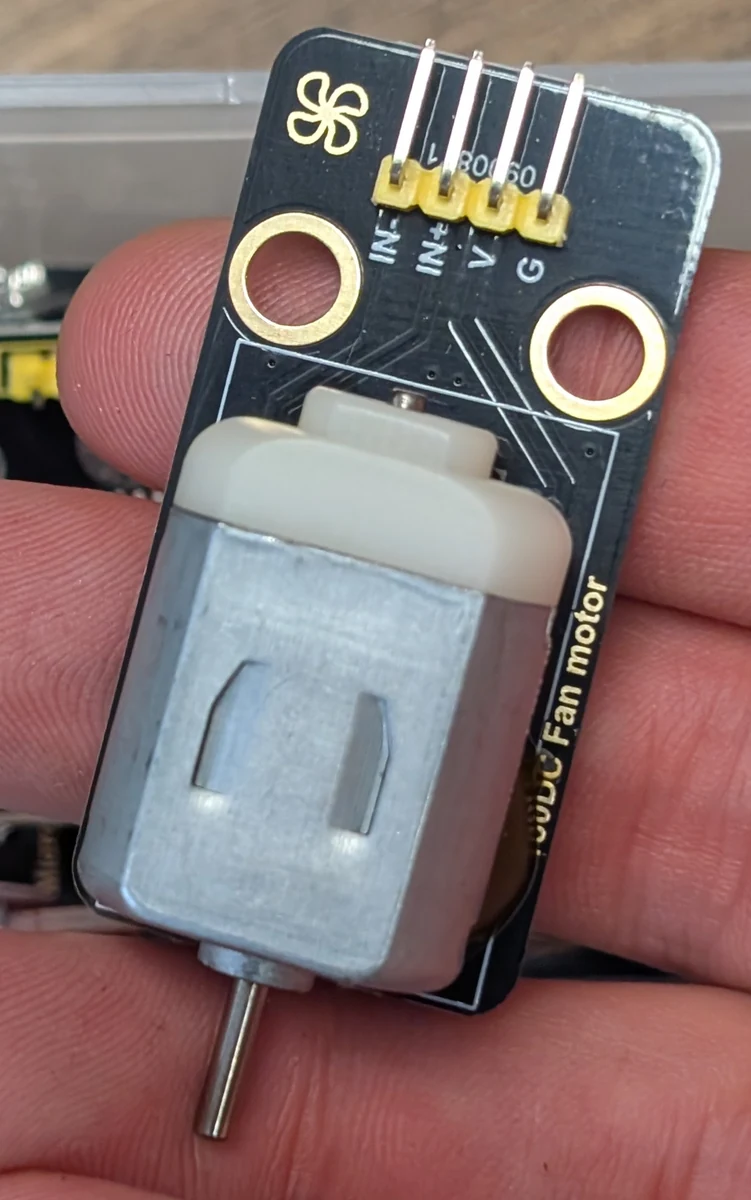
A small brushed DC motorproduces continuous rotation from DC power, with direction set by current polarity.
Two motor terminals
Solves a continuous-motion task rather than a positioning task. Higher winding voltage generally raises speed under similar load, while load torque raises current. A freely spinning test gives no assurance that startup or stalled current fits the driver.
Brushes and a commutator switch rotor-winding current as the rotor turns. Magnetic forces between rotor and stator create torque. Rotating windings generate back EMF; when the shaft stalls back EMF disappears and current rises sharply.
Small metal motor can with projecting shaft and two electrical terminals; exact voltage and current remain unverified.
Also called: 130 DC Motor, motor
Use a transistor plus flyback path for one direction, or an H-bridge for reversing. Supply from a rated external rail and share controller ground. Check motor label, start with a conservative current-limited supply, and measure startup/load current. Use PWM for average speed; feedback would be needed for precise speed or position.
required for bidirectional control
A bridge switches winding current and direction instead of loading GPIO.
A motor-rated supply delivers startup/current transients independently of signal pins.
intermediate
Control a small brushed motor while measuring driver voltage loss and startup behavior.
Read the conditions before connecting parts. A relationship can involve a driver, controller or a redesigned circuit.
motor driver
actuator control
Actuation strategy choice; position, incremental motion and continuous rotation are different requirements.
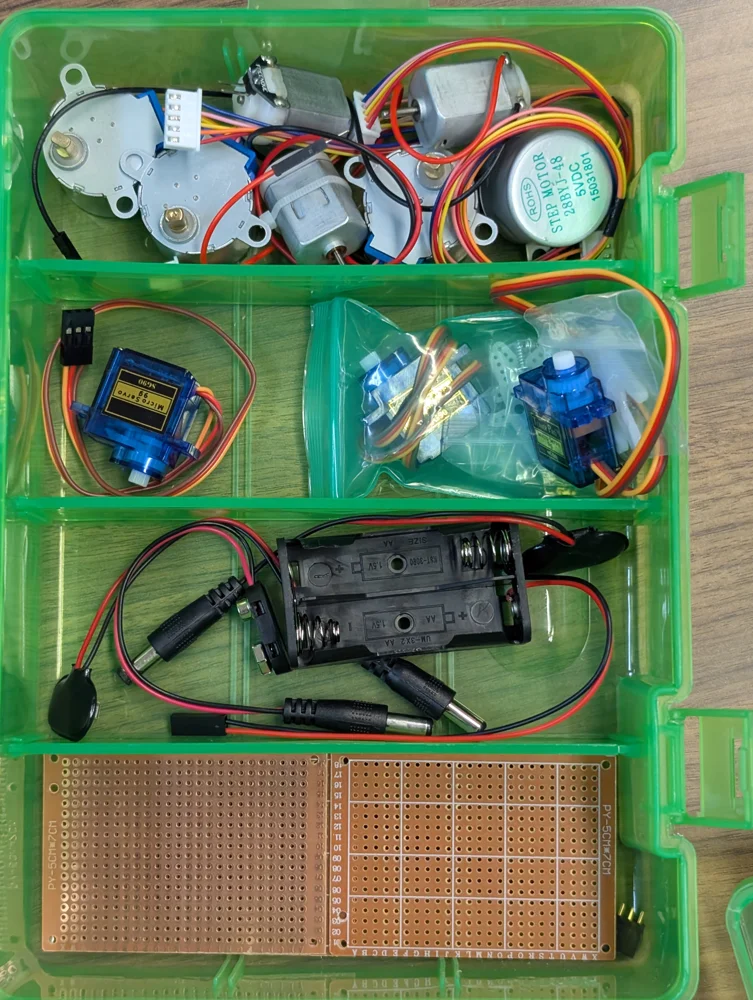
Use SG90 for a simple angular setting, 28BYJ-48 for slow incremental motion with measured gear/step calibration, and a brushed motor for continuous speed/rotation. Precise absolute motion needs feedback; none becomes interchangeable just by changing a PWM value.
Researched external products, separate from club inventory. Price and availability are not promised.
Pololu
Low motor voltage and driver losses make a verified low-voltage MOSFET H-bridge useful.
Low motor voltage and driver losses make a verified low-voltage MOSFET H-bridge useful. Choose this path only when the stated improvement is a requirement.
Texas Instruments
The motor subsystem needs explicit current control/monitoring and a voltage envelope beyond a basic teaching H-bridge.
The motor subsystem needs explicit current control/monitoring and a voltage envelope beyond a basic teaching H-bridge. Choose this path only when the stated improvement is a requirement.
Quantity: 1 · quantity confidence: high
Known countable purchase/BOM contributions. Each source line is a total; do not multiply by container count or add photo observations.
Ownership: source-backed club holding. Identity confidence: high.
Identity follows exact kit sheet/BOM; expected quantity is not a physical stocktake.
V1 establishes the catalog identity. Technical references explain the named device or component class; unverified carrier-specific ratings and pinouts are not asserted.
Original V3 image confidence: 90% · high. Component crop tied to an owned kit and its source mapping; selected by form rather than filename alone.
Original V3 image source: Freenove FNK0020 older sheet (owned kit reference). Images describe identity and form; they do not establish quantity.
Displayed image source: Freenove FNK0020 older sheet; user-approved V2 image cleanup.
User explicitly authorized integration of approved entries from the supplied V2 decisions export. Exact reviewed candidate bytes retained; original inventory identity, confidence and hardware facts remain unchanged.
Original reference image rights retained; cleanup does not change attribution or license.