beginner
Low-voltage diode asymmetry bench
Core electronics availableMeasure forward and reverse behavior in a resistor-limited circuit.
Discrete Components
A small-signal switching diode that conducts mainly from anode to cathode for steering or rectification.
Two-terminal polarized junction
Steers small signals and supports fast switching at loads within its as-yet-unverified rating; it is not automatically a power freewheel diode.
A PN junction forms a depletion barrier. Forward bias lowers the barrier and allows current; reverse bias largely blocks it until breakdown. Stored charge, current and temperature determine switching/recovery and forward drop, so 0.7 V is not a universal fixed rating.
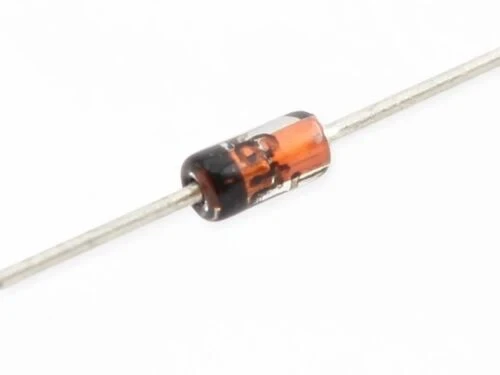
Small glass axial diode with a cathode band. The band marks cathode; diode-test mode verifies forward behavior but not maximum ratings.
Also called: switch diode
Identify cathode and actual model first. For rectification follow the circuit polarity; for a DC coil flyback diode place cathode at coil positive and anode at the switched low side. Size current, reverse voltage and switching speed for the load; check power dissipation.
beginner
Measure forward and reverse behavior in a resistor-limited circuit.
Read the conditions before connecting parts. A relationship can involve a driver, controller or a redesigned circuit.
polarity verification
rectification experiment
Quantity: 2 · quantity confidence: high
Known countable purchase/BOM contributions. Each source line is a total; do not multiply by container count or add photo observations.
Ownership: source-backed club holding. Identity confidence: high.
Identity follows exact kit sheet/BOM; expected quantity is not a physical stocktake.
V1 establishes the catalog identity. Technical references explain the named device or component class; unverified carrier-specific ratings and pinouts are not asserted.
Original V3 image confidence: 90% · high. Component crop tied to an owned kit and its source mapping; selected by form rather than filename alone.
Original V3 image source: Freenove FNK0020 older sheet (owned kit reference). Images describe identity and form; they do not establish quantity.
Displayed image source: User-supplied Small-signal switching diode reference photograph.
Glass-bodied axial small-signal diode form reference; no exact diode part number or electrical rating is established by the photograph.
User-supplied reference image; original rights retained.