ULN2003 stepper driver module
GPIO cannot deliver winding current; the driver sinks coil current and clamps turn-off transients.
- Check the actual motor voltage and carrier connection.
Motors & Actuators
A 28BYJ-48 is a small geared unipolar stepper that advances its output shaft when coil phases are energized in sequence.
4-phase drive through compatible driver · Motor phase coils; five-wire unipolar connector class
Provides slow indexed motion and holding torque for lightweight mechanisms. A program counts commanded steps instead of reading an internal position sensor; if load or acceleration causes missed steps, the software position becomes wrong.
Sequential stator magnetic fields pull a permanent-magnet rotor to new alignments. A reduction geartrain turns many rotor steps into a smaller output movement and more torque. Full-step and half-step excitation use different counts; gears also introduce backlash. Coil current must pass through a driver, not GPIO.
Permanent-magnet rotor/stator coil assembly with an internal reduction geartrain.
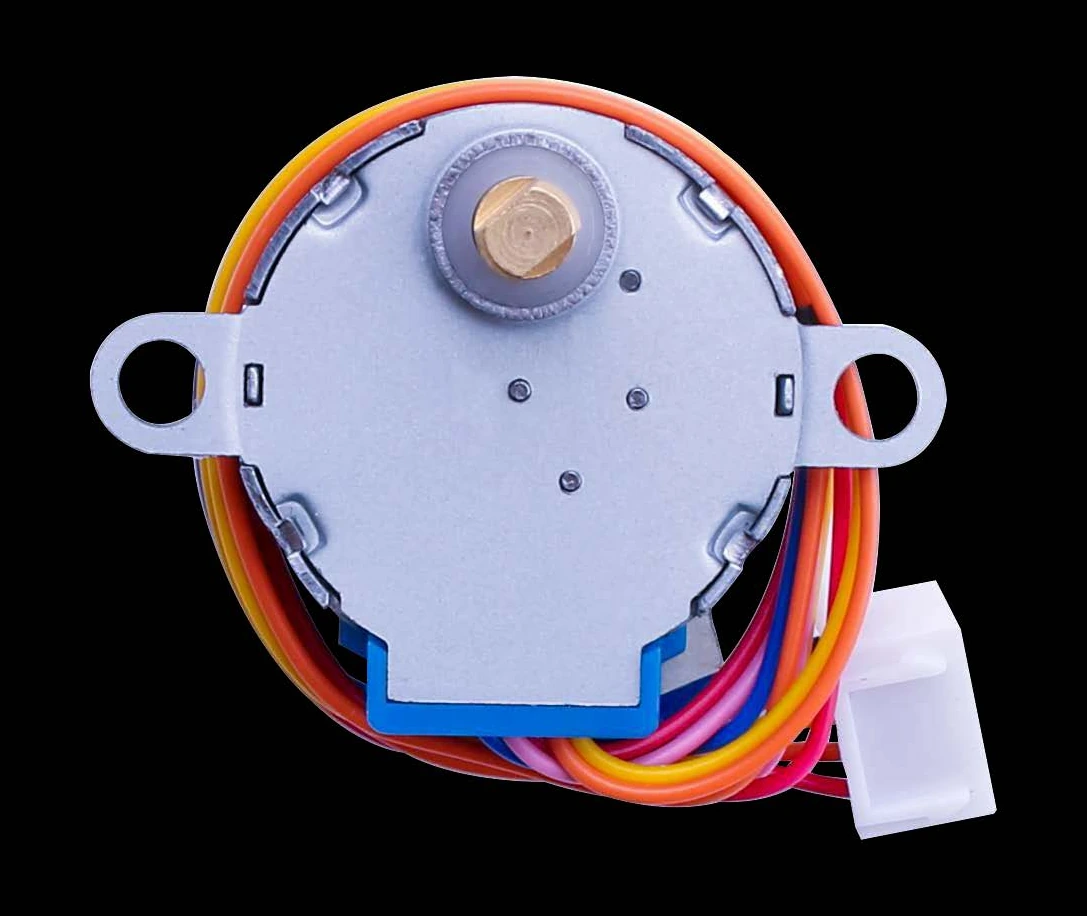
Small round motor can with mounting tabs, offset geared shaft and a five-wire plug on typical unipolar versions. Read its voltage label; 5 V and other winding variants exist.
Also called: 28BYJ-48, Stepper Motor, stepping motor, stepper motor
Verify rated winding voltage and use a compatible current-sinking driver such as the ULN2003 board. Supply the coil common from motor power, share control ground and sequence four phase inputs. Start slowly and ramp rate, then measure actual steps per output revolution before precision work. De-energize when holding torque is unnecessary to reduce heat.
GPIO cannot deliver winding current; the driver sinks coil current and clamps turn-off transients.
Coil power needs a supply that matches the motor label and operating current.
intermediate
Move between measured output angles with acceleration limits and a documented home reference.
Read the conditions before connecting parts. A relationship can involve a driver, controller or a redesigned circuit.
motor driver
phase sequencing
kit learning anchor
kit learning anchor
kit learning anchor
Actuation strategy choice; position, incremental motion and continuous rotation are different requirements.
Use SG90 for a simple angular setting, 28BYJ-48 for slow incremental motion with measured gear/step calibration, and a brushed motor for continuous speed/rotation. Precise absolute motion needs feedback; none becomes interchangeable just by changing a PWM value.
Researched external products, separate from club inventory. Price and availability are not promised.
Pololu
A redesigned bipolar-stepper motion subsystem needs regulated coil current and STEP/DIR microstepping rather than the existing unipolar gearmotor drive.
A redesigned bipolar-stepper motion subsystem needs regulated coil current and STEP/DIR microstepping rather than the existing unipolar gearmotor drive. Choose this path only when the stated improvement is a requirement.
Official product / documentation ↗
Companion: SOYO (official vendor reference: Pololu) NEMA 17 42×48 mm stepper, Pololu product 1200 · not owned
SOYO (official vendor reference: Pololu)
The mechanism has outgrown the small geared unipolar motor and needs a documented larger motor/driver redesign.
The mechanism has outgrown the small geared unipolar motor and needs a documented larger motor/driver redesign. Choose this path only when the stated improvement is a requirement.
Official product / documentation ↗
Companion: Pololu DRV8825 Stepper Motor Driver Carrier, product 2133 · not owned
Quantity: 4 · quantity confidence: high
Known countable purchase/BOM contributions. Each source line is a total; do not multiply by container count or add photo observations.
Ownership: source-backed club holding. Identity confidence: high.
Identity follows exact kit sheet/BOM; expected quantity is not a physical stocktake.
V1 establishes the catalog identity. Technical references explain the named device or component class; unverified carrier-specific ratings and pinouts are not asserted.
Original V3 image confidence: 90% · high. Component crop tied to an owned kit and its source mapping; selected by form rather than filename alone.
Original V3 image source: Freenove FNK0020 older sheet (owned kit reference). Images describe identity and form; they do not establish quantity.
Displayed image source: ELEGOO — The Most Complete Starter Kit for MEGA 2560 tutorial — The Most Complete Starter Kit for MEGA V1.0.2021.05.13.pdf, page 208, image xref 755 (supplied selection metadata).
Round geared motor, offset shaft, mounting tabs and five-wire plug match the canonical 28BYJ-48 class. The visible front does not establish winding voltage; read the actual motor label before powering.
Illustration © ELEGOO. All rights reserved. Used for the Engineering Club educational website under club-reported permission; no broader license is granted.