Arduino Uno R3
required for programmed audio
The host supplies the switching or frequency command.
- Bare units may also require an external transistor stage; active and passive command patterns differ.

Motors & Actuators
An active buzzer contains an oscillator and makes a tone when supplied with its rated DC drive.
DC/on-off control
Gives a simple on/off alert without the controller synthesizing an audio frequency. Modulating its supply can make beep patterns, but the internal oscillator largely sets the tone.
Electrical excitation moves a diaphragm through a piezoelectric or magnetic mechanism, depending on the actual sounder. Internal circuitry generates repeated excitation from DC. The exact transducer technology is unverified.
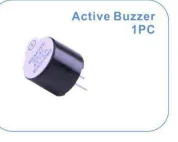
Round sounder with two leads and often a polarity mark. Active and passive cans can look identical; use markings or a safe rated-voltage test.
Also called: Active Buzzer, active buzzer, piece active buzzer
Check voltage/current and polarity; use a transistor when required beyond GPIO capability. Switch the rated supply/control input for beep timing.
required for programmed audio
The host supplies the switching or frequency command.
intermediate
Compare active on/off tones with passive host-generated pitch using current-qualified switching.
Read the conditions before connecting parts. A relationship can involve a driver, controller or a redesigned circuit.
audio output
user feedback
Audible indication strategy; fixed tone and host-generated pitch require different control.
Choose active devices for an on/off indication and passive devices for pitch control. Replacing one with the other changes software timing and possibly the transistor/power arrangement.
The bare/carrier pair provides the same underlying component class when the fitted circuitry is identified.
A passive unit can produce an alarm if the host generates its waveform.
Quantity: 5 · quantity confidence: high
Known countable purchase/BOM contributions. Each source line is a total; do not multiply by container count or add photo observations.
Ownership: source-backed club holding. Identity confidence: high.
Identity follows exact kit sheet/BOM; expected quantity is not a physical stocktake.
V1 establishes the catalog identity. Technical references explain the named device or component class; unverified carrier-specific ratings and pinouts are not asserted.
Original V3 image confidence: 90% · high. Component crop tied to an owned kit and its source mapping; selected by form rather than filename alone.
Original V3 image source: Freenove FNK0020 older sheet (owned kit reference). Images describe identity and form; they do not establish quantity.
Displayed image source: ELEGOO — The Most Complete Starter Kit for MEGA 2560 tutorial — The Most Complete Starter Kit for MEGA V1.0.2021.05.13.pdf, page 66, image xref 227 (supplied selection metadata).
Bare round sounder and marked polarity match the current active-buzzer reference. Active identity relies on the supplied source labeling (page 66), not shell appearance or a physical electrical test.
Illustration © ELEGOO. All rights reserved. Used for the Engineering Club educational website under club-reported permission; no broader license is granted.