Arduino Uno R3
A host converts demodulated pulses into button commands.
- Receiver data is not a continuous analog light level.
Communication
An infrared receiver carrier converts a modulated remote-control light signal into digital pulse timing.
Digital receive output; optical input
Lets software decode remote buttons from pulse patterns. It usually suppresses the optical carrier and exposes the message envelope; the output is not raw light intensity or the remote’s original carrier wave.
An IR photodetector, amplifier, band-pass filtering and demodulator respond to an appropriate carrier frequency. Automatic gain control rejects some ambient light; software then interprets the pulse intervals according to a protocol.
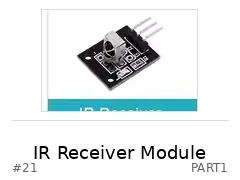
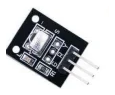
Black or blue PCB with a three-lead IR detector and header. Receiver housings and three-pin packages have different pin orders between models.
Also called: ir receiver module, infrared receiver module, IR Receiver
Identify receiver pinout, supply and expected carrier band. Connect its demodulated output to a host-safe input and use a compatible IR decoder. Point the remote at it, log actual button codes and handle repeat frames. Check polarity; many demodulating receivers idle high and pulse low.
A host converts demodulated pulses into button commands.
intermediate
Decode remote buttons and change a current-limited three-color indicator without blocking repeat handling.
Read the conditions before connecting parts. A relationship can involve a driver, controller or a redesigned circuit.
infrared command
command decoding
Quantity: 3 · quantity confidence: probable
Known countable purchase/BOM contributions. Each source line is a total; do not multiply by container count or add photo observations.
Ownership: source-backed club holding. Identity confidence: high.
Identity follows exact kit sheet/BOM; expected quantity is not a physical stocktake.
V1 establishes the catalog identity. Technical references explain the named device or component class; unverified carrier-specific ratings and pinouts are not asserted.
Original V3 image confidence: 90% · high. Component crop tied to an owned kit and its source mapping; selected by form rather than filename alone.
Original V3 image source: ELEGOO Mega reference (owned kit reference). Images describe identity and form; they do not establish quantity.
Displayed image source: ELEGOO Mega reference; user-approved V2 image cleanup.
User explicitly authorized integration of approved entries from the supplied V2 decisions export. Exact reviewed candidate bytes retained; original inventory identity, confidence and hardware facts remain unchanged.
Original reference image rights retained; cleanup does not change attribution or license.