beginner
Compare obstacle and line reflectivity thresholds
Core electronics availableTest how target color, distance and mounting height change two reflective IR module outputs.
Kits / Parent kit
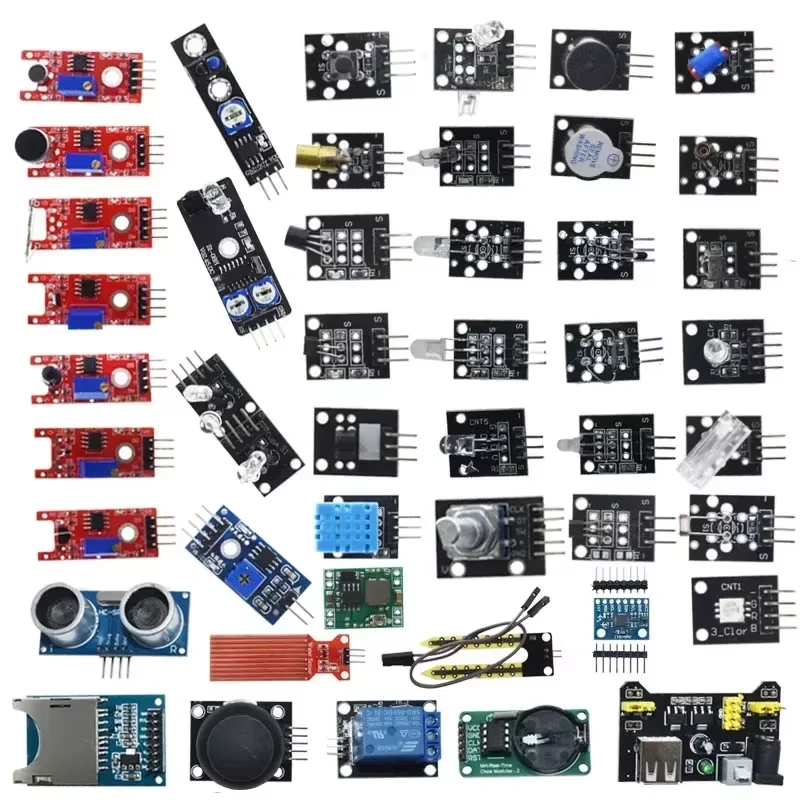
The Arduino / Raspberry Pi 45-in-1 sensor assortment supports host-independent module experiments with voltage-compatible controllers; it is a parent learning package rather than one electronic component.
Mechanical contacts, optical/magnetic sensing, temperature-related inputs, sound and indicator modules provide a sequence of tangible experiments. Begin by identifying each source-backed slot and its signal class, then test one documented module at a time before combining circuits. The educational value comes from measuring and explaining each circuit rather than just replaying supplied code.
Mechanical contacts, optical/magnetic sensing, temperature-related inputs, sound and indicator modules provide a sequence of tangible experiments. Begin by identifying each source-backed slot and its signal class, then test one documented module at a time before combining circuits. The educational value comes from measuring and explaining each circuit rather than just replaying supplied code. Each element converts a particular physical input into an electrical signal, or converts drive power into an output. Interpret the individual circuit before combining modules.
Match the Arduino / Raspberry Pi 45-in-1 sensor assortment package label and supplied component sheet. Identify individual sensing heads or mechanical assemblies separately; similar carrier boards do not establish an exact sensor IC.
Also called: Mixed sensor assortment
Begin by identifying each source-backed slot and its signal class, then test one documented module at a time before combining circuits. Before each lesson, use the individual component record to check power, signal levels and driver needs. Keep the frozen source holding/BOM as the ownership reference and use current documentation only for technical learning. Seller slots/artwork do not establish 45 uniquely identified sensors; ambiguous sensing heads and repeated IR slots remain unresolved.
These links follow the frozen source holding lines. Kit and component quantities describe different units; do not add them as a stock total.
beginner
Test how target color, distance and mounting height change two reflective IR module outputs.
beginner
Compare a mini reed module and digital Hall module at controlled magnet gaps.
beginner
Compare event timing from bare tilt and vibration switches using identical debouncing rules.
intermediate
Characterize soil and water-trace modules while minimizing continuous electrode excitation.
club-wide demonstrator; not a claim that every required component belongs to this kit
club-wide demonstrator; not a claim that every required component belongs to this kit
club-wide demonstrator; not a claim that every required component belongs to this kit
club-wide demonstrator; not a claim that every required component belongs to this kit
Read the conditions before connecting parts. A relationship can involve a driver, controller or a redesigned circuit.
kit learning anchor
kit learning anchor
Quantity: 1 · quantity confidence: confirmed
Purchased kit-container count; excluded from component-unit aggregate.
Ownership: source-backed club holding. Identity confidence: probable.
Legacy photographed or listed component class; exact model may be unresolved.
Parent identity and contributions remain frozen. Technical learning descriptions do not assert a new BOM or complete current physical stock.
Original V3 image confidence: 82% · high. Physical club photograph supports the visible component class; full scene retained as evidence.
Original V3 image source: Engineering Club photographs (physical photo). Images describe identity and form; they do not establish quantity.
Displayed image source: User-supplied Arduino / Raspberry Pi 45-in-1 sensor assortment reference photograph.
User-selected sensor-assortment reference. Pictured modules and marketed assortment count do not replace the frozen source BOM, quantities or hardware identities.
User-supplied reference image; original rights retained.