What it does
Projects a visible/optical spot for low-voltage demonstrations when its rating and handling requirements are known. Unlike a diffused LED, its beam can retain a concentrated intensity at a distance.
Useful specifications
- Wavelength/power/class/supply
- Unconfirmed; verify actual label/documentation
How it works
A semiconductor laser uses optical feedback and stimulated emission to amplify light in a cavity. A lens collimates the output. Current control is essential; an unknown carrier may or may not include a suitable limiting circuit.
Recognize the part
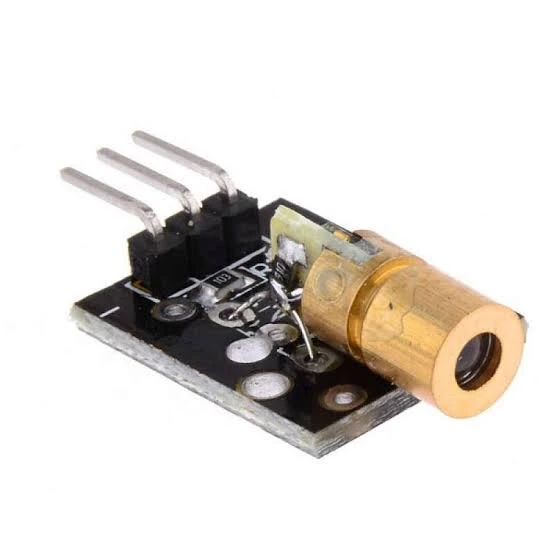
Brass cylindrical optical head mounted on a PCB, with a small output aperture. Read any wavelength/power/class label; housing shape does not establish eye safety.
Also called: Laser Emission
How to use it
Identify supply, required current limiting and optical class before energizing. Fix the module so the beam terminates on a matte stop, below eye level, and use only a documented low-power teaching setup. Do not aim at people, animals or reflective objects.
Know before using
Limits
- Exact optical hazard and drive limits are unknown.
- Beam optics differ from LED indicators.
Common mistakes
- Assuming a brass hobby emitter is eye-safe.
- Removing current limiting.
Care and safety
- Avoid direct or reflected viewing of the beam; do not energize an unrated emitter in an uncontrolled setup.
Related owned hardware
Read the conditions before connecting parts. A relationship can involve a driver, controller or a redesigned circuit.
gated optical output
- After optical/driver identification, Uno can switch a verified low-power laser carrier for an optical fixture.
Connection conditions
- Optical power/class, supply and built-in current regulation are unverified; obtain that evidence first.
- Control GPIO cannot replace a laser constant-current driver; avoid eye exposure/specular reflections.
preconnection verification
- Check identified supply/input nodes without looking into the emitter.
Connection conditions
- A meter cannot establish laser eye safety or optical power.
Inventory record and image evidence
Quantity: 1 · quantity confidence: probable
Known countable purchase/BOM contributions. Each source line is a total; do not multiply by container count or add photo observations.
Ownership: source-backed club holding. Identity confidence: probable.
Supported by source contribution; unresolved variant and source details remain on its holding.
V1 establishes the catalog identity. Technical references explain the named device or component class; unverified carrier-specific ratings and pinouts are not asserted.
Source holdings
Parent kits
Original V3 image confidence: 75% · probable. Seller reference matches the component class; exact carrier revision is not established by this artwork.
Original V3 image source: 45-in-1 seller sheet (seller reference). Images describe identity and form; they do not establish quantity.
Displayed image source: User-supplied Laser emitter module, optical rating unconfirmed reference photograph.
User-selected laser emitter module reference. Optical output, wavelength and laser class remain unconfirmed; the photograph does not establish safe operating conditions.
User-supplied reference image; original rights retained.