Arduino Uno R3
required for programmed audio
The host supplies the switching or frequency command.
- Bare units may also require an external transistor stage; active and passive command patterns differ.
Motors & Actuators
A passive sounder needs an alternating drive waveform; software frequency selects the audible pitch.
Alternating tone drive
Converts a timed waveform into sound for melodies or alarms. Applying steady DC is not a useful continuous-tone command.
Electrical excitation moves a diaphragm through a piezoelectric or magnetic mechanism, depending on the actual sounder. The controller/driver must generate repeated excitation. The exact transducer technology is unverified.
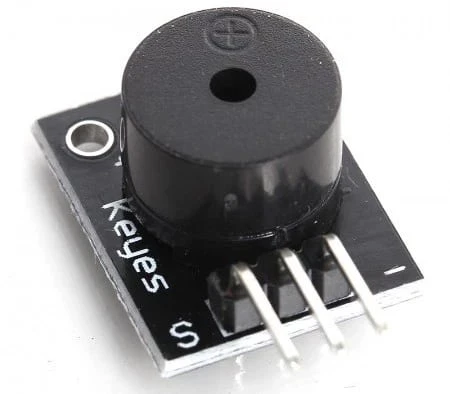
PCB with round sounder and signal header. Active and passive cans can look identical; use markings or a safe rated-voltage test.
Also called: Passive Buzzer
Verify carrier power/control labels and whether an onboard transistor handles current. Drive with an audio-frequency square wave using a tone/timer facility; use an appropriate driver and suppression if it is an inductive magnetic sounder.
required for programmed audio
The host supplies the switching or frequency command.
Read the conditions before connecting parts. A relationship can involve a driver, controller or a redesigned circuit.
audio output
user feedback
Audible indication strategy; fixed tone and host-generated pitch require different control.
Choose active devices for an on/off indication and passive devices for pitch control. Replacing one with the other changes software timing and possibly the transistor/power arrangement.
The bare/carrier pair provides the same underlying component class when the fitted circuitry is identified.
Quantity: 1 · quantity confidence: probable
Known countable purchase/BOM contributions. Each source line is a total; do not multiply by container count or add photo observations.
Ownership: source-backed club holding. Identity confidence: probable.
Supported by source contribution; unresolved variant and source details remain on its holding.
V1 establishes the catalog identity. Technical references explain the named device or component class; unverified carrier-specific ratings and pinouts are not asserted.
Original V3 image confidence: 75% · probable. Seller reference matches the component class; exact carrier revision is not established by this artwork.
Original V3 image source: 45-in-1 seller sheet (seller reference). Images describe identity and form; they do not establish quantity.
Displayed image source: User-supplied Passive buzzer module reference photograph.
User-selected passive buzzer module reference, distinct from bare buzzers and the active buzzer module; electrical behavior remains untested.
User-supplied reference image; original rights retained.