Arduino Uno R3
required for programmed response
A controller interprets the event and controls any display, alarm or actuator.
- Allow warm-up and do not interpret silence as proof of an empty room.
Sensors
A passive infrared motion module detects changing heat patterns across its field of view and returns a motion-trigger signal.
Power, ground and motion output
Triggers when a warm object moves between optical zones, making it useful for presence-triggered lighting or alarms. A stationary person may disappear from the signal; it does not report body temperature, a distance, or a count of people.
Pyroelectric elements develop charge when absorbed infrared energy changes. Opposing sensing regions suppress uniform background changes. The segmented Fresnel lens maps spatial zones onto them; carrier amplifiers and timing logic turn a changing pattern into a digital pulse.
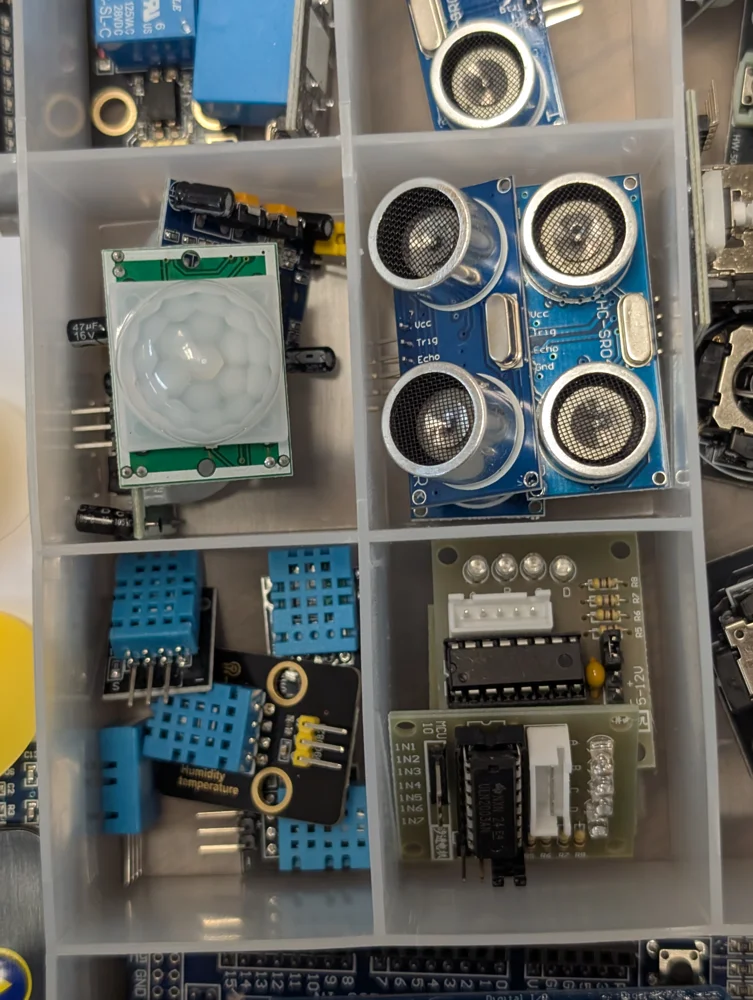
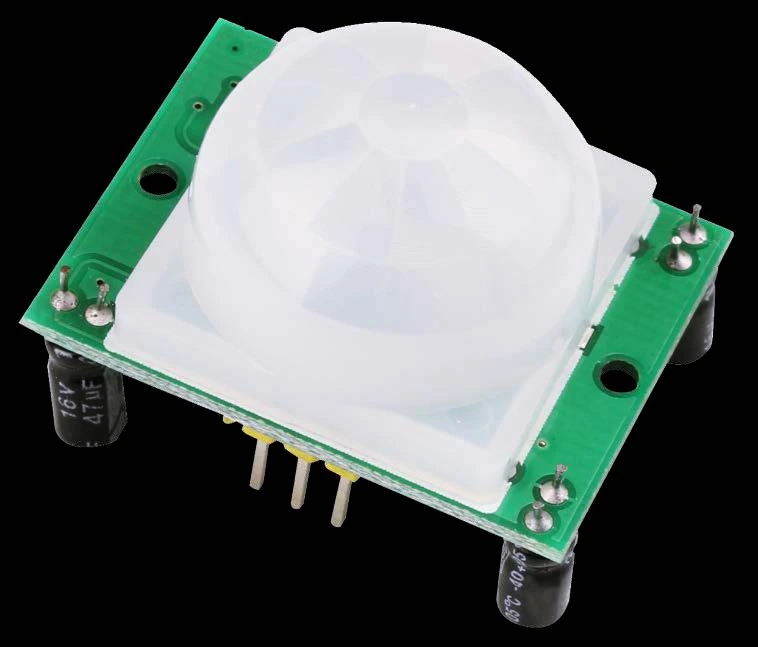
White faceted Fresnel dome over a PCB. Some versions have sensitivity/delay trimmers or retrigger jumpers; their presence and function must be checked on the actual carrier.
Also called: PIR Motion Sensor, infrared motion sensor, hc sr501 pir motion sensor
Verify supply and pin order on this board, then read its output as a digital input after warm-up. Establish idle and triggered output voltages before wiring. Test people walking across the zones; configure retrigger/delay only if those controls are documented.
required for programmed response
A controller interprets the event and controls any display, alarm or actuator.
beginner
Record thermal-motion events and hold an LED for a defined interval without claiming occupancy certainty.
Read the conditions before connecting parts. A relationship can involve a driver, controller or a redesigned circuit.
event input
event input
event indication
Measurement-method choice; motion, distance, contrast and beam events are not equivalent outputs.
Choose the physical quantity you need: PIR for motion events, sonar for acoustic range, reflective IR for a threshold or line contrast, and a slot for a passing flag. Their outputs cannot be substituted as equivalent occupancy or distance measurements.
Quantity: 3 · quantity confidence: high
Known countable purchase/BOM contributions. Each source line is a total; do not multiply by container count or add photo observations.
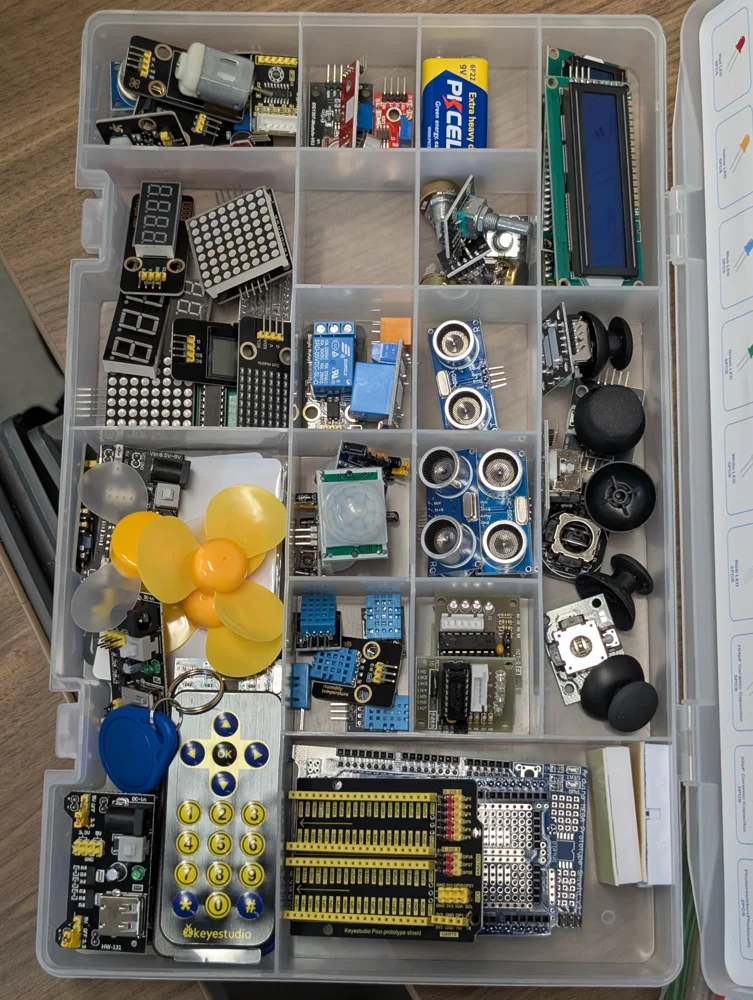
Ownership: source-backed club holding. Identity confidence: high.
Identity follows exact kit sheet/BOM; expected quantity is not a physical stocktake.
V1 establishes the catalog identity. Technical references explain the named device or component class; unverified carrier-specific ratings and pinouts are not asserted.
Original V3 image confidence: 90% · high. Component crop tied to an owned kit and its source mapping; selected by form rather than filename alone.
Original V3 image source: ELEGOO Mega reference (owned kit reference). Images describe identity and form; they do not establish quantity.
Displayed image source: ELEGOO — The Most Complete Starter Kit for MEGA 2560 tutorial — The Most Complete Starter Kit for MEGA V1.0.2021.05.13.pdf, page 123, image xref 433 (supplied selection metadata).
Fresnel dome, carrier and three-pin header match the canonical PIR module class and current primary. No exact HC-SR501 revision, jumper behavior or pin order is asserted.
Illustration © ELEGOO. All rights reserved. Used for the Engineering Club educational website under club-reported permission; no broader license is granted.