Arduino Uno R3
required for digital readout
An ADC-equipped controller converts the signal voltage into readings.
- For Pi 4/5 use a separately identified ADC; their GPIO headers have no general-purpose analog input.
Discrete Components
A screwdriver-adjusted trimmer forms an adjustable voltage divider for calibration or a user control.
Three terminals; analog wiper output
The wiper position selects a voltage between the two track ends. Used as a divider it gives an ADC a setting signal; used with two terminals it gives a variable resistance, subject to track and wiper ratings.
A sliding contact touches a resistive track. The two end-to-wiper resistances change in opposite directions, while end-to-end resistance stays approximately fixed.
Resistive track and movable metal wiper; trimmers trade repeated ergonomic adjustment for a compact calibration setting.
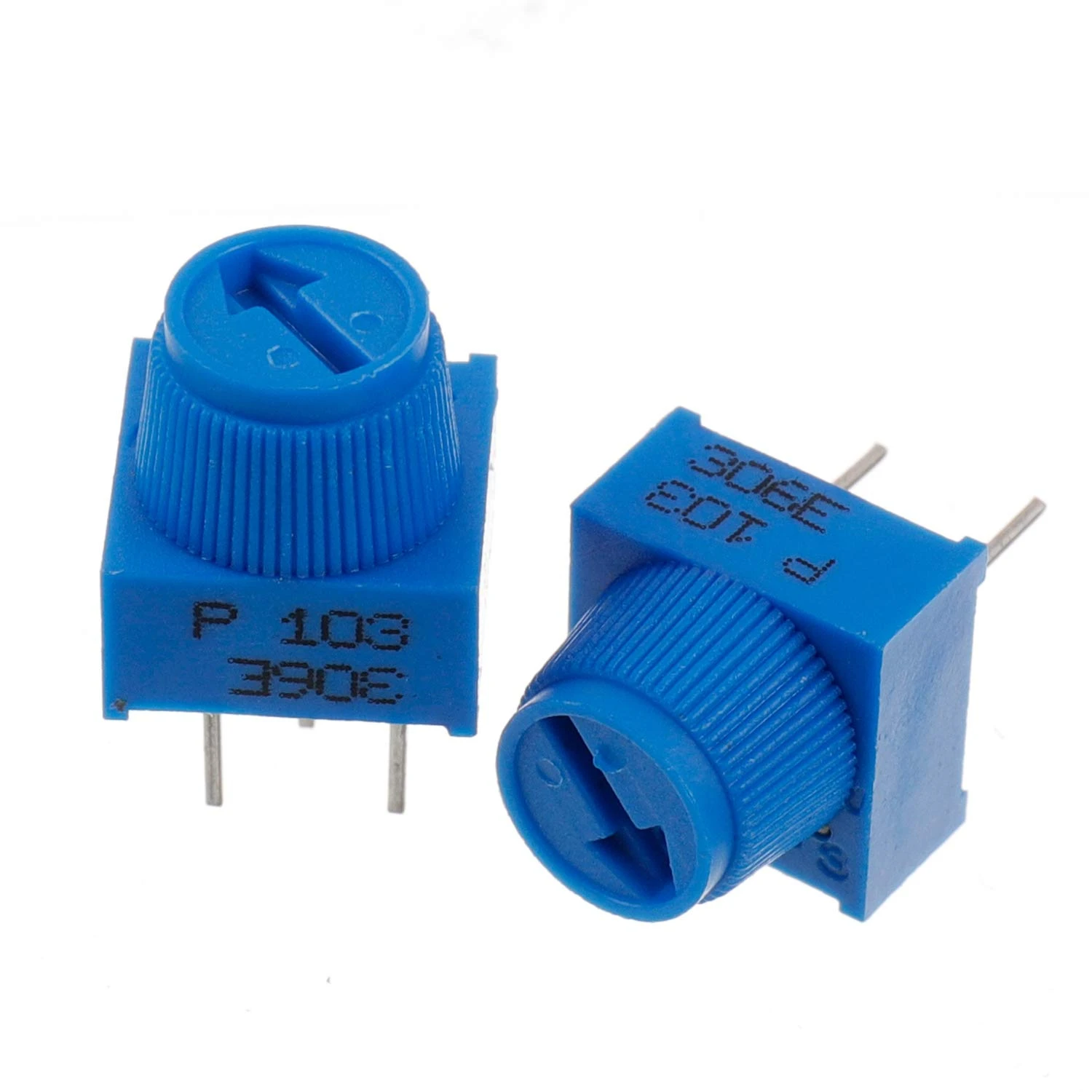
Blue square screwdriver-adjusted trimmer shown in the KS3020 source crop and PXL_20260924_195451704.jpg. Identify both track ends and wiper with an unpowered resistance measurement.
Also called: 10K Ohm Potentiometer
Wire track ends to an ADC-safe reference/supply and ground, then send the wiper to an analog input. Keep the signal inside the ADC rails. Use a trimmer screwdriver gently and calibrate the intended setpoint.
required for digital readout
An ADC-equipped controller converts the signal voltage into readings.
beginner
Bring up a bare LCD1602 and learn why backlight, contrast and controller initialization are separate.
Read the conditions before connecting parts. A relationship can involve a driver, controller or a redesigned circuit.
analog measurement
analog measurement
measurement
User-control strategy; absolute wipers, relative steps and two-axis commands are different semantics.
A potentiometer reports an absolute setting within its travel; an encoder reports increments that software must accumulate. A trimmer is for occasional adjustment. Choose a joystick when two independent analog axes are useful.
Quantity: 1 · quantity confidence: high
Known countable purchase/BOM contributions. Each source line is a total; do not multiply by container count or add photo observations.
Ownership: source-backed club holding. Identity confidence: high.
Supplied exact-owned-kit image and club photograph establish the distinct form. Kit quantity is an expectation, not a stocktake.
V1 establishes the catalog identity. Technical references explain the named device or component class; unverified carrier-specific ratings and pinouts are not asserted.
Original V3 image confidence: 97% · high. Visible bare/carrier/trimmer form checked against canonical identity; source-kit crop retained at native resolution.
Original V3 image source: Keyestudio KS3020 (owned kit reference). Images describe identity and form; they do not establish quantity.
Displayed image source: User-supplied potentiometer-10k-trimmer reference image attached in chat.
User-selected blue trimmer reference bears the 103 value marking and retains both physical views and all visible terminal pins. It does not establish the exact owned manufacturer, pin orientation or quantity.
User-supplied reference image; original rights retained.