Arduino Uno R3
required for digital readout
An ADC-equipped controller converts the signal voltage into readings.
- For Pi 4/5 use a separately identified ADC; their GPIO headers have no general-purpose analog input.
Discrete Components
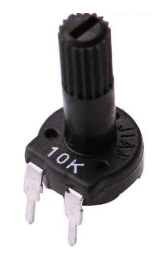
A shaft-operated potentiometer forms an adjustable voltage divider for calibration or a user control.
Three terminals; analog wiper output
The wiper position selects a voltage between the two track ends. Used as a divider it gives an ADC a setting signal; used with two terminals it gives a variable resistance, subject to track and wiper ratings.
A sliding contact touches a resistive track. The two end-to-wiper resistances change in opposite directions, while end-to-end resistance stays approximately fixed.
Resistive track and movable metal wiper; trimmers trade repeated ergonomic adjustment for a compact calibration setting.
Three terminals and a rotating shaft; resistance marking must read 10 kΩ. Identify both track ends and wiper with an unpowered resistance measurement.
Also called: 10K Ohm Potentiometer, potentiometer 10k
Wire track ends to an ADC-safe reference/supply and ground, then send the wiper to an analog input. Keep the signal inside the ADC rails. Turn the shaft gently and calibrate the intended setpoint.
required for digital readout
An ADC-equipped controller converts the signal voltage into readings.
beginner
Sweep a 10 kΩ wiper and compare meter voltage with quantized Uno ADC codes.
beginner
Control each RGB channel separately and compare duty-cycle mixing with electrical current limits.
intermediate
Publish a measured potentiometer setting and explicit timestamp over a local network.
intermediate
Use Pico for timed ADC acquisition and Pi 4 for storage, plots and process-level networking.
advanced
Receive ESP32 telemetry on Pi 5 and store validated data with stale-reading indicators.
advanced
Separate sensor-control code from a UART-connected radio module and observe two-processor failure modes.
Read the conditions before connecting parts. A relationship can involve a driver, controller or a redesigned circuit.
analog measurement
analog measurement
measurement
analog telemetry
User-control strategy; absolute wipers, relative steps and two-axis commands are different semantics.
A potentiometer reports an absolute setting within its travel; an encoder reports increments that software must accumulate. A trimmer is for occasional adjustment. Choose a joystick when two independent analog axes are useful.
Both can set a low-current divider voltage when occasional adjustment is sufficient.
Quantity: 2 · quantity confidence: high
Known countable purchase/BOM contributions. Each source line is a total; do not multiply by container count or add photo observations.
Ownership: source-backed club holding. Identity confidence: high.
Identity follows exact kit sheet/BOM; expected quantity is not a physical stocktake.
V1 establishes the catalog identity. Technical references explain the named device or component class; unverified carrier-specific ratings and pinouts are not asserted.
Original V3 image confidence: 90% · high. Component crop tied to an owned kit and its source mapping; selected by form rather than filename alone.
Original V3 image source: ELEGOO Mega reference (owned kit reference). Images describe identity and form; they do not establish quantity.
Displayed image source: ELEGOO Mega reference; user-approved V2 image cleanup.
User explicitly authorized integration of approved entries from the supplied V2 decisions export. Exact reviewed candidate bytes retained; original inventory identity, confidence and hardware facts remain unchanged.
Original reference image rights retained; cleanup does not change attribution or license.