Site Guide

Find your way around the Engineering Club.

Know what you need? Search for a component, concept or project.

Around the site

Start

Labs

TestingExperimental

Build

Club

LearnExperimental

Go a little deeper

Entry points to larger collections. Use Search for individual records.

Learning paths & reference

Inside PiCrawlerExperimental

Inside Inventory

← Club inventory
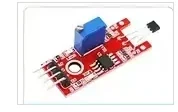
Uncertain reference image for Linear Hall sensor module, identity unconfirmedImage uncertain

Sensors

Linear Hall sensor module, identity unconfirmed

A seller-labeled linear Hall carrier has an unresolved sensing identity.

Owned by clubQuantity: 1Identification needs review
  • Uncertain primary image: Seller reuses this comparator/TO-92 artwork under incompatible captions. It is not proof of the named sensing head.
  • 45-in-1 seller caption/visual or mechanism ambiguity remains unresolved.

Analog and/or comparator output; carrier-dependent

What it does

If the label is correct, it supports relative magnetic-field measurement; the reused seller artwork does not establish a linear sensing head.

Useful specifications

IC/sensitivity/supply
Unverified for carrier
Output class
Probable analog field-related
How it works

Current flowing through a sensing layer is deflected by a perpendicular magnetic field, producing a transverse Hall voltage. Integrated electronics amplify it. A linear IC exposes a continuous signal, often offset around an internal bias; a comparator output on the carrier is a separate threshold signal.

Recognize the part

Comparator-style board; inspect the actual sensor marking. Read the three-lead sensing IC marking; a thermistor carrier can have a misleadingly similar PCB.

Also called: Linear Hall

How to use it

Verify the actual sensing head before powering; no precise pinout is provided. For analog use measure the no-magnet baseline, then reverse magnet poles and compare. For digital use identify active level and whether a pull-up or opposite pole is required to release the output.

Know before using

Limits

  • Orientation and magnet distance change readings.
  • No calibrated field strength without the actual transfer curve.

Common mistakes

  • Confusing a comparator LED with calibrated field strength.
  • Assuming every Hall switch unlatches when the magnet is removed.

What you need with it

required

Source-specific schematic/datasheet or actual IC and board markings; safe signal characterization

required before electrical use

Exact interface and electrical limits must be established before a reliable controller/driver relationship can be claimed.

Related owned hardware

Read the conditions before connecting parts. A relationship can involve a driver, controller or a redesigned circuit.

preconnection verification

AstroAI digital multimeter

  • Use unpowered continuity/resistance and identified test points to characterize the source-backed class before choosing a host.

Connection conditions

  • Do not infer supply, pinout, sensing IC or driver from a similar photograph.

prototyping

830-point solderless breadboard

  • After identification, an isolated low-voltage test fixture makes pin and signal checks visible.

Connection conditions

  • A breadboard is not protection: obtain supply/pinout evidence before applying power.

Documentation

Inventory record and image evidence

Quantity: 1 · quantity confidence: uncertain

Known countable purchase/BOM contributions. Each source line is a total; do not multiply by container count or add photo observations.

Ownership: source-backed club holding. Identity confidence: uncertain.

Supported by source contribution; unresolved variant and source details remain on its holding.

Known: seller linear-Hall slot. Probable: Hall-related carrier class. Unknown: actual element, IC, output topology and electrical limits; reused imagery does not settle identity.

Source holdings

Parent kits

Image confidence: 30% · uncertain. Seller reuses this comparator/TO-92 artwork under incompatible captions. It is not proof of the named sensing head.

Image source: 45-in-1 seller sheet: seven captions reuse this visual (seller reference). Images describe identity and form; they do not establish quantity.