Site Guide

Find your way around the Engineering Club.

Know what you need? Search for a component, concept or project.

Around the site

Start

Labs

TestingExperimental

Build

Club

LearnExperimental

Go a little deeper

Entry points to larger collections. Use Search for individual records.

Learning paths & reference

Inside PiCrawlerExperimental

Inside Inventory

← Club inventory
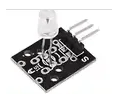
Infrared LED transmitter module

Communication

Infrared LED transmitter module

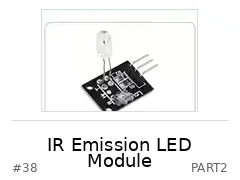
An infrared LED transmitter carrier emits modulated IR light for a compatible receiver; the two seller IR-emission slots remain unreconciled by V2.

Owned by clubQuantity: 2Identification needs review
  • Two 45-in-1 IR-emission slots may be equivalent or distinct variants.

LED drive; emitted optical signal

What it does

Allows a controller to send remote-control patterns when it can provide the proper carrier and timing. An emitter has no received-data output, and any duplicated seller slots remain as frozen source contributions rather than newly split or merged types.

Useful specifications

Wavelength/current/carrier circuit
Unconfirmed
How it works

A semiconductor junction emits infrared photons under forward current. Rapidly switching that current creates an optical carrier; message timing turns bursts on and off. A carrier may include a resistor or transistor, but its exact circuit is not established.

Recognize the part

Small PCB with an optical LED emitter. Read pin labels and inspect resistor/driver components; invisible emission cannot be identified reliably by eye.

Also called: IR Emission

How to use it

Verify supply, polarity and onboard current limiting first. Use a driver if the required pulse current exceeds GPIO capability, and generate the carrier/protocol expected by the receiver. Test with a known receiver rather than direct viewing; a phone camera response is only an informal check.

Know before using

Limits

  • Line of sight and receiver carrier compatibility.
  • Exact equivalence of the two seller slots remains unresolved.

Common mistakes

  • Calling it an IR receiver.
  • Removing current limiting to increase range.

Care and safety

  • Keep LED and driver pulse current within identified ratings.

What you need with it

required

Source-specific schematic/datasheet or actual IC and board markings; safe signal characterization

required before electrical use

Exact interface and electrical limits must be established before a reliable controller/driver relationship can be claimed.
Related owned hardware

Read the conditions before connecting parts. A relationship can involve a driver, controller or a redesigned circuit.

preconnection verification

AstroAI digital multimeter

  • Use unpowered continuity/resistance and identified test points to characterize the source-backed class before choosing a host.

Connection conditions

  • Do not infer supply, pinout, sensing IC or driver from a similar photograph.

prototyping

830-point solderless breadboard

  • After identification, an isolated low-voltage test fixture makes pin and signal checks visible.

Connection conditions

  • A breadboard is not protection: obtain supply/pinout evidence before applying power.

Documentation

Inventory record and image evidence

Quantity: 2 · quantity confidence: uncertain

Known countable purchase/BOM contributions. Each source line is a total; do not multiply by container count or add photo observations.

Ownership: source-backed club holding. Identity confidence: uncertain.

Supported by source contribution; unresolved variant and source details remain on its holding.

Emitter class is useful, but V1 review about repeated 45-in-1 slots is preserved. No equivalence claim or inventory merge/split is made.

Source holdings

Parent kits

Original V3 image confidence: 65% · probable. Seller slots depict an IR-emitter class. Two expected contributions remain; emitter wavelength and exact board revision are unknown.

Original V3 image source: 45-in-1 seller sheet (seller reference). Images describe identity and form; they do not establish quantity.

Displayed image source: 45-in-1 seller sheet; user-approved V2 image cleanup.

User explicitly authorized integration of approved entries from the supplied V2 decisions export. Exact reviewed candidate bytes retained; original inventory identity, confidence and hardware facts remain unchanged.

Original reference image rights retained; cleanup does not change attribution or license.