Arduino Uno R3
required for programmed response
A controller interprets the event and controls any display, alarm or actuator.
- Set mounting height and calibrate against actual dark/light surfaces.
Sensors
An optical module detects contrasting a dark line against a reflective surface and exposes a photodetector signal or threshold event.
Analog detector or digital threshold
A downward-facing emitter/detector compares returned light from the track. The same black/white pattern can read differently on glossy or IR-reflective materials.
An infrared LED emits light and a phototransistor converts received photons into current. The amount reflected depends on distance, angle and surface reflectance. Carrier circuitry may amplify or compare it with a threshold.
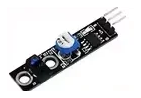
Small PCB with adjacent emitter and detector facing the surface.
Also called: Tracking
Verify power, output polarity and whether the pin is analog or comparator output. Establish blocked/clear or dark/light readings at the intended geometry. Keep the optics clean and shield from strong ambient light; recalibrate a trimmer for the actual surface.
required for programmed response
A controller interprets the event and controls any display, alarm or actuator.
beginner
Test how target color, distance and mounting height change two reflective IR module outputs.
Read the conditions before connecting parts. A relationship can involve a driver, controller or a redesigned circuit.
event input
event input
event indication
Measurement-method choice; motion, distance, contrast and beam events are not equivalent outputs.
Choose the physical quantity you need: PIR for motion events, sonar for acoustic range, reflective IR for a threshold or line contrast, and a slot for a passing flag. Their outputs cannot be substituted as equivalent occupancy or distance measurements.
Quantity: 1 · quantity confidence: probable
Known countable purchase/BOM contributions. Each source line is a total; do not multiply by container count or add photo observations.
Ownership: source-backed club holding. Identity confidence: probable.
Supported by source contribution; unresolved variant and source details remain on its holding.
V1 establishes the catalog identity. Technical references explain the named device or component class; unverified carrier-specific ratings and pinouts are not asserted.
Original V3 image confidence: 75% · probable. Seller reference matches the component class; exact carrier revision is not established by this artwork.
Original V3 image source: 45-in-1 seller sheet (seller reference). Images describe identity and form; they do not establish quantity.
Displayed image source: 45-in-1 seller sheet; user-approved V2 image cleanup.
User explicitly authorized integration of approved entries from the supplied V2 decisions export. Exact reviewed candidate bytes retained; original inventory identity, confidence and hardware facts remain unchanged.
Original reference image rights retained; cleanup does not change attribution or license.