Arduino Uno R3
required for programmed response
A controller interprets the event and controls any display, alarm or actuator.
- Distance, target reflectivity and sunlight affect the threshold; this is not calibrated ranging.
Sensors
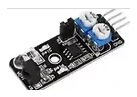
An optical module detects reflecting infrared from a nearby object and exposes a photodetector signal or threshold event.
Analog detector or digital threshold
A reflective obstacle carrier flags a returned IR signal, but does not provide a calibrated distance.
An infrared LED emits light and a phototransistor converts received photons into current. The amount reflected depends on distance, angle and surface reflectance. Carrier circuitry may amplify or compare it with a threshold.
PCB with paired optical elements and adjustment trim.
Also called: Avoidance
Verify power, output polarity and whether the pin is analog or comparator output. Establish blocked/clear or dark/light readings at the intended geometry. Keep the optics clean and shield from strong ambient light; recalibrate a trimmer for the actual surface.
required for programmed response
A controller interprets the event and controls any display, alarm or actuator.
beginner
Test how target color, distance and mounting height change two reflective IR module outputs.
Read the conditions before connecting parts. A relationship can involve a driver, controller or a redesigned circuit.
event input
event input
event indication
Measurement-method choice; motion, distance, contrast and beam events are not equivalent outputs.
Choose the physical quantity you need: PIR for motion events, sonar for acoustic range, reflective IR for a threshold or line contrast, and a slot for a passing flag. Their outputs cannot be substituted as equivalent occupancy or distance measurements.
Researched external products, separate from club inventory. Price and availability are not promised.
STMicroelectronics
The design needs optical ranging or a controllable measurement region rather than an acoustic range estimate or IR threshold event.
The design needs optical ranging or a controllable measurement region rather than an acoustic range estimate or IR threshold event. Choose this path only when the stated improvement is a requirement.
Quantity: 1 · quantity confidence: probable
Known countable purchase/BOM contributions. Each source line is a total; do not multiply by container count or add photo observations.
Ownership: source-backed club holding. Identity confidence: probable.
Supported by source contribution; unresolved variant and source details remain on its holding.
V1 establishes the catalog identity. Technical references explain the named device or component class; unverified carrier-specific ratings and pinouts are not asserted.
Original V3 image confidence: 75% · probable. Seller reference matches the component class; exact carrier revision is not established by this artwork.
Original V3 image source: 45-in-1 seller sheet (seller reference). Images describe identity and form; they do not establish quantity.
Displayed image source: 45-in-1 seller sheet; user-approved V2 image cleanup.
User explicitly authorized integration of approved entries from the supplied V2 decisions export. Exact reviewed candidate bytes retained; original inventory identity, confidence and hardware facts remain unchanged.
Original reference image rights retained; cleanup does not change attribution or license.