Arduino Uno R3
required for programmed response
A controller interprets the event and controls any display, alarm or actuator.
- A passing flag makes pulses; an external disk/flag is needed to relate them to movement.
Sensors
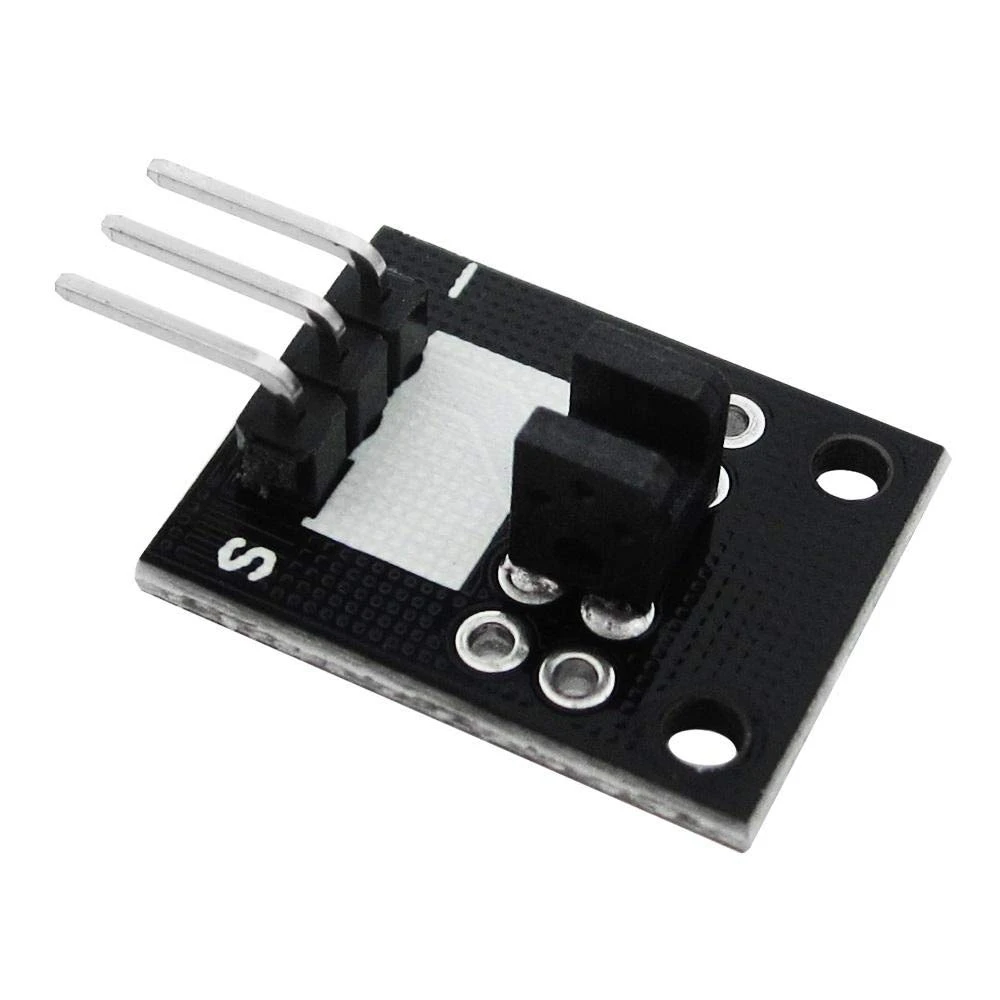
An optical module detects interrupting a beam inside a slot and exposes a photodetector signal or threshold event.
Analog detector or digital threshold
A slotted photointerrupter detects an object placed between emitter and receiver, suitable for counting tabs or finding a mechanism reference point.
An infrared LED emits light and a phototransistor converts received photons into current. Blocking the direct beam reduces detector current. Carrier circuitry may amplify or compare it with a threshold.
U-shaped optical slot on a carrier.
Also called: Light Blocking
Verify power, output polarity and whether the pin is analog or comparator output. Establish blocked/clear or dark/light readings at the intended geometry. Keep the optics clean and shield from strong ambient light; recalibrate a trimmer for the actual surface.
required for programmed response
A controller interprets the event and controls any display, alarm or actuator.
intermediate
Convert slot interruptions into measured rotation rate with a known flag count.
Read the conditions before connecting parts. A relationship can involve a driver, controller or a redesigned circuit.
event input
event input
event indication
Measurement-method choice; motion, distance, contrast and beam events are not equivalent outputs.
Choose the physical quantity you need: PIR for motion events, sonar for acoustic range, reflective IR for a threshold or line contrast, and a slot for a passing flag. Their outputs cannot be substituted as equivalent occupancy or distance measurements.
Quantity: 1 · quantity confidence: probable
Known countable purchase/BOM contributions. Each source line is a total; do not multiply by container count or add photo observations.
Ownership: source-backed club holding. Identity confidence: probable.
Supported by source contribution; unresolved variant and source details remain on its holding.
V1 establishes the catalog identity. Technical references explain the named device or component class; unverified carrier-specific ratings and pinouts are not asserted.
Original V3 image confidence: 75% · probable. Seller reference matches the component class; exact carrier revision is not established by this artwork.
Original V3 image source: 45-in-1 seller sheet (seller reference). Images describe identity and form; they do not establish quantity.
Displayed image source: User-supplied Slotted photointerrupter module reference photograph.
User-selected slotted optical interrupter carrier reference; pin assignment and owned device identity remain source-based.
User-supplied reference image; original rights retained.