Arduino Uno R3
required for digital readout
An ADC-equipped controller converts the signal voltage into readings.
- For Pi 4/5 use a separately identified ADC; their GPIO headers have no general-purpose analog input.
Sensors
Exposed conductive tracks detect whether water bridges part of a PCB, giving a wetness or approximate immersion signal.
Analog output; carrier-dependent
Provides a simple water-presence indication or rough level trend along the tracks. It does not independently measure depth in millimeters or recognize chemically pure water reliably.
Water containing ions conducts between interleaved tracks. The carrier converts that conductance into a voltage; immersed area and liquid conductivity both affect it.
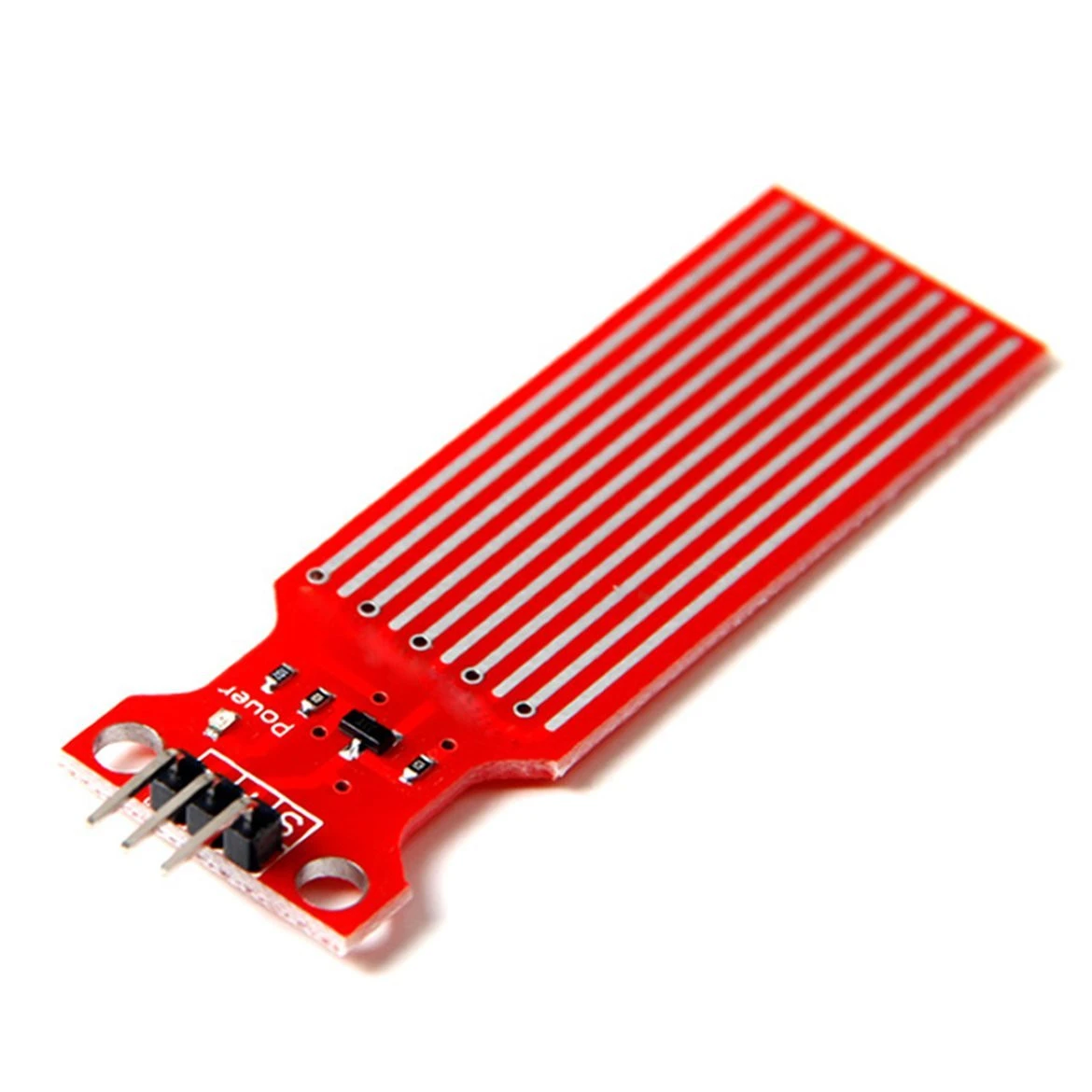
Narrow board with long exposed parallel/interleaved copper tracks below the connector region.
Also called: water level detection sensor module, Water Level Detection Sensor Module
Check supply and analog-output labels. Wet only the sensing tracks, compare dry and intended-liquid readings, and calibrate thresholds at known levels. Power intermittently when possible and dry/clean the tracks after use.
required for digital readout
An ADC-equipped controller converts the signal voltage into readings.
intermediate
Characterize soil and water-trace modules while minimizing continuous electrode excitation.
Read the conditions before connecting parts. A relationship can involve a driver, controller or a redesigned circuit.
analog measurement
analog measurement
measurement
Quantity: 2 · quantity confidence: probable
Known countable purchase/BOM contributions. Each source line is a total; do not multiply by container count or add photo observations.
Ownership: source-backed club holding. Identity confidence: high.
Identity follows exact kit sheet/BOM; expected quantity is not a physical stocktake.
V1 establishes the catalog identity. Technical references explain the named device or component class; unverified carrier-specific ratings and pinouts are not asserted.
Original V3 image confidence: 90% · high. Component crop tied to an owned kit and its source mapping; selected by form rather than filename alone.
Original V3 image source: ELEGOO Mega reference (owned kit reference). Images describe identity and form; they do not establish quantity.
Displayed image source: User-supplied Water-level detection module reference photograph.
User-selected water-level detection carrier reference retaining complete traces, electronics and three-pin header. Probe range, pinout and electrical behavior remain source-based.
User-supplied reference image; original rights retained.