What it does
Joining two male board headers uses the different pin/socket ends to avoid soldering. The wire carries whatever net is connected; color is a labeling convention, not a built-in polarity function.
Useful specifications
- Ends
- Female-to-female
- Wire gauge/current rating
- Not established; treat as signal leads
How it works
A metal conductor inside insulation links two crimped contacts. Contact and wire resistance produce voltage drop; long loops also collect interference and add inductance.
Recognize the part
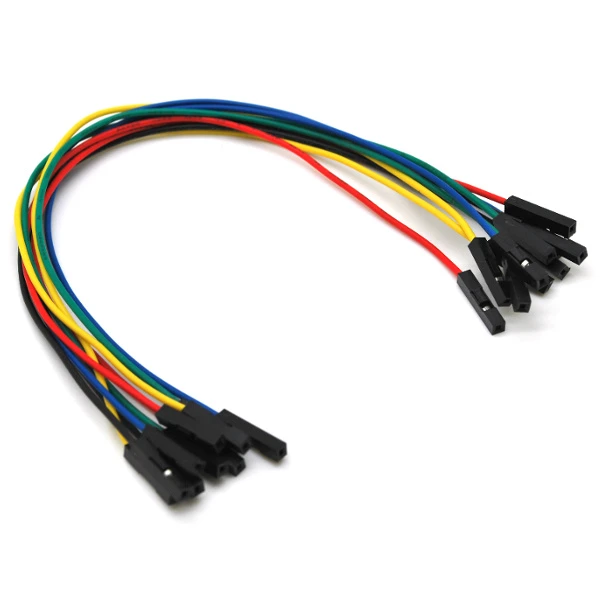
Socket at both ends. Check intact insulation and snug contacts before use.
Also called: Female-to-Female Dupont Wires, 10 jump wire f f
How to use it
Power down before changing connections, follow the schematic net by net and use consistent colors for rails. Keep bus/analog leads short and check questionable leads for continuity.
Know before using
Limits
- Loose contacts and long leads impair reliable prototypes.
- Not a high-current motor/panel supply path.
Common mistakes
- Trusting wire color without tracing the connection.
- Using a pin end in an oversized/loose contact.
Related owned hardware
Read the conditions before connecting parts. A relationship can involve a driver, controller or a redesigned circuit.
prototyping
- Female ends link two exposed male-header connectors; the breadboard needs an appropriate male-header transition.
Connection conditions
- Signal/prototype currents only unless gauge/contact ratings are verified; avoid high-current panel/motor paths.
connector pairing
- Matched pin/socket gender bridges the appropriate carrier or prototype connection.
Connection conditions
- Confirm pitch, contact direction and insulation; gender alone does not establish pin mapping.
Inventory record and image evidence
Quantity: 50 · quantity confidence: high
Known countable purchase/BOM contributions. Each source line is a total; do not multiply by container count or add photo observations.
Ownership: source-backed club holding. Identity confidence: high.
Identity follows exact kit sheet/BOM; expected quantity is not a physical stocktake.
V1 establishes the catalog identity. Technical references explain the named device or component class; unverified carrier-specific ratings and pinouts are not asserted.
Source holdings
Parent kits
Original V3 image confidence: 90% · high. Component crop tied to an owned kit and its source mapping; selected by form rather than filename alone.
Original V3 image source: Freenove FNK0020 older sheet (owned kit reference). Images describe identity and form; they do not establish quantity.
Displayed image source: User-supplied wire-ff reference image attached in chat.
User-selected reference shows socket housings at both ends of the flexible jumper leads. All visible connectors and wires retained; image count does not establish inventory quantity.
User-supplied reference image; original rights retained.