Arduino Uno R3
A device-specific host reads registers/conversions and interprets them.
- Dallas 1-Wire needs a suitable pull-up and conversion wait; verify chip/carrier supply and pin order.
Sensors
A DS18B20 measures temperature digitally and uses a unique address so several sensors can share one 1-Wire data line.
Dallas/Maxim 1-Wire; unique 64-bit ROM
Reports a converted temperature with configurable precision and a checksum, avoiding an external ADC. Addressing makes it useful for several measurement points on one cable, though the club carrier is not automatically waterproof.
An internal semiconductor temperature circuit is digitized and placed in a scratchpad. The host requests conversion, waits, then reads temperature and CRC. The ROM identifier selects a particular chip on a multidrop bus.
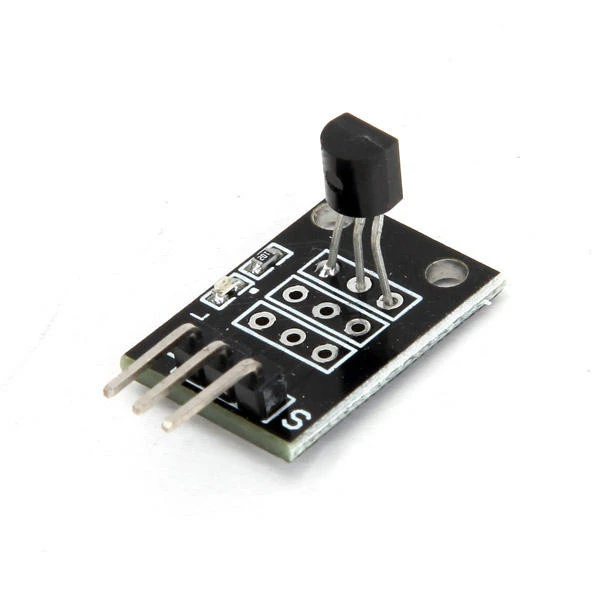
Carrier with a three-lead package marked DS18B20; distinguish it from visually similar LM35 and transistors using the actual marking.
Also called: 18B20 Temp
Prefer ordinary powered operation: connect documented VDD/GND and pull data up to a host-safe rail. Verify any onboard pull-up. Use a 1-Wire library, enumerate addresses and wait for conversion completion before reading. Parasite power needs special current handling, not just omission of VDD.
A device-specific host reads registers/conversions and interprets them.
required if carrier lacks pullup
The corrected 5.1 kΩ resistor is close to the common 4.7 kΩ 1-Wire starting value.
intermediate
Acquire DS18B20 conversions using device identity and explicit conversion waiting.
intermediate
Record resistance-related output versus reference temperature rather than borrowing an unknown Beta curve.
Read the conditions before connecting parts. A relationship can involve a driver, controller or a redesigned circuit.
digital temperature
local display
support hardware · pull up
Temperature-measurement strategy; humidity and calibration requirements can rule out alternatives.
Use DHT11 only when humidity matters and modest accuracy is sufficient. DS18B20 provides addressed digital temperature. LM35 produces a temperature-proportional voltage with supply constraints. Thermistors are useful for resistance/calibration lessons; nominal resistance alone does not justify Celsius values.
Researched external products, separate from club inventory. Price and availability are not promised.
Texas Instruments
A calibrated local-temperature requirement exceeds an uncharacterized analog conversion or coarse sensor subsystem.
A calibrated local-temperature requirement exceeds an uncharacterized analog conversion or coarse sensor subsystem. Choose this path only when the stated improvement is a requirement.
Quantity: 1 · quantity confidence: probable
Known countable purchase/BOM contributions. Each source line is a total; do not multiply by container count or add photo observations.
Ownership: source-backed club holding. Identity confidence: probable.
Supported by source contribution; unresolved variant and source details remain on its holding.
V1 establishes the catalog identity. Technical references explain the named device or component class; unverified carrier-specific ratings and pinouts are not asserted.
Original V3 image confidence: 75% · probable. Seller reference matches the component class; exact carrier revision is not established by this artwork.
Original V3 image source: 45-in-1 seller sheet (seller reference). Images describe identity and form; they do not establish quantity.
Displayed image source: User-supplied DS18B20 temperature sensor module reference photograph.
User-selected DS18B20 carrier reference; the photographed module does not verify the owned sensor authenticity or wiring.
User-supplied reference image; original rights retained.