Raspberry Pi Pico 2 W
The host supplies display-specific data, initialization and refresh/scan behavior.
- Use exact (G) waveform/driver, SPI/control pins and BUSY completion; no partial-refresh claim.
Displays
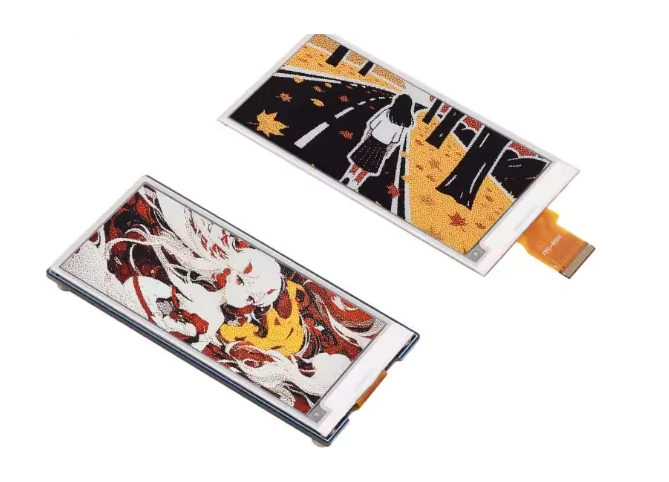
The Waveshare 3.5-inch e-Paper (G) is a 384×184 four-color reflective display that retains a static image without continuous panel drive.
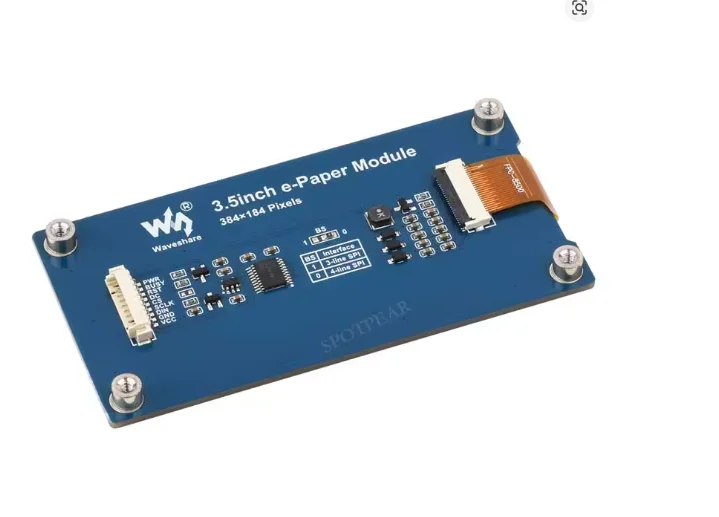
SPI; CS; DC; reset; BUSY
Suits labels, schedules and slowly updated instrument/status pages. It produces red, yellow, black and white pixels and remains legible in ambient light. The driver board supplies the panel-specific voltage sequences; there is no need to scan the same still image repeatedly.
Electric fields move differently charged colored pigment particles within electrophoretic cells. Their resulting arrangement remains after drive is removed. Updating requires a controlled multi-stage waveform, so visible flashing and long settling are part of the refresh process, not an LCD-style frame cycle.
Charged pigment cells under a transparent front layer and an addressable electrode structure; driver PCB generates panel waveforms.
3.5-inch panel with driver PCB and flexible display connection, identified as the (G) 384×184 RYBW model. Other 3.5-inch or monochrome Waveshare panels are not equivalent driver targets.
Also called: E-ink display with driver PCB
Follow the exact (G) manual and example driver for the installed board. Verify header supply/logic tolerance, then connect the documented SPI lines plus chip-select, data/command, reset and busy. Wait for BUSY completion with a timeout. Send correctly encoded four-color image data, finish the refresh and place the panel/driver into sleep as instructed. Keep updates infrequent and follow the manufacturer’s refresh/maintenance guidance; no partial-refresh capability is asserted.
The host supplies display-specific data, initialization and refresh/scan behavior.
intermediate
Display a manually supplied or locally served status on the exact Waveshare (G) panel with a slow refresh schedule.
Read the conditions before connecting parts. A relationship can involve a driver, controller or a redesigned circuit.
spi display
user interface
Display choice for a task after information density, refresh, power and interface review.
Pick information density and refresh behavior first. Text does not require a framebuffer; a persistent e-paper label does not behave like a video screen. MAX7219 offloads scanning while bare matrices expose driver design. P5 offers a large color surface with materially greater power/timing demands. The four-digit carrier remains unsuitable for assumed driver-specific projects until identified.
E-ink display with driver PCB: 1 individual units · received
View wishlist →Quantity: 1 · quantity confidence: confirmed
Known countable purchase/BOM contributions. Each source line is a total; do not multiply by container count or add photo observations.
Ownership: source-backed club holding. Identity confidence: confirmed.
Exact product explicitly confirmed owned by user; quantity comes from a separate holding, not this image.
Exact four-color model remains established. Official indexed manual/product were found but direct fetch was blocked; no unverified numerical supply or partial-refresh claim is added.
Original V3 image confidence: 98% · confirmed. Supplied exact-owned product reference; visible model/form checked. Image is not a physical receipt or count.
Original V3 image source: Confirmed exact products (exact product). Images describe identity and form; they do not establish quantity.
Displayed image source: Confirmed exact products; user-approved V2 image cleanup.
User explicitly authorized integration of approved entries from the supplied V2 decisions export. Exact reviewed candidate bytes retained; original inventory identity, confidence and hardware facts remain unchanged.
Original reference image rights retained; cleanup does not change attribution or license.