220 Ω resistor
The bare junction does not limit current; each driven channel needs a calculated series resistor.
- 220 Ω is one owned candidate; use a larger value if required by voltage/LED/GPIO limits.
Displays
A green indicator LED converts forward current into visible light; use it for status indication with a series resistor.
Two-lead polarized light emitter
Provides a green visible output whose brightness mainly depends on forward current. PWM changes average brightness by switching the LED rapidly.
Electrons and holes recombine in a semiconductor junction and release photons. Material and junction design set wavelength and forward voltage; the LED is not a resistor and does not safely set its own current.
A semiconductor die is bonded to a lead frame and covered by a lens; white LEDs normally add a phosphor layer.
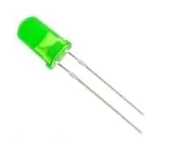
Green two-lead dome. Lead length may have been trimmed; confirm polarity with diode test.
Also called: green led, Green LED
Connect anode toward positive and cathode toward ground through a calculated resistor. Begin with a low-current indication setting. Blue/white LEDs can have less voltage headroom from 3.3 V than red LEDs; measure forward drop.
The bare junction does not limit current; each driven channel needs a calculated series resistor.
beginner
Count deliberate button presses once each and report the count over USB serial.
beginner
Implement timed red/yellow/green states with a button request and a safe startup state.
beginner
Record thermal-motion events and hold an LED for a defined interval without claiming occupancy certainty.
intermediate
Decode remote buttons and change a current-limited three-color indicator without blocking repeat handling.
Read the conditions before connecting parts. A relationship can involve a driver, controller or a redesigned circuit.
visual output
current limiting
polarity verification
support hardware
Quantity: 19 · quantity confidence: high
Known countable purchase/BOM contributions. Each source line is a total; do not multiply by container count or add photo observations.
Ownership: source-backed club holding. Identity confidence: high.
Identity follows exact kit sheet/BOM; expected quantity is not a physical stocktake.
V1 establishes the catalog identity. Technical references explain the named device or component class; unverified carrier-specific ratings and pinouts are not asserted.
Original V3 image confidence: 90% · high. Component crop tied to an owned kit and its source mapping; selected by form rather than filename alone.
Original V3 image source: Freenove FNK0020 older sheet (owned kit reference). Images describe identity and form; they do not establish quantity.
Displayed image source: Freenove FNK0020 older sheet; user-approved V2 image cleanup.
User explicitly authorized integration of approved entries from the supplied V2 decisions export. Exact reviewed candidate bytes retained; original inventory identity, confidence and hardware facts remain unchanged.
Original reference image rights retained; cleanup does not change attribution or license.