Site Guide

Find your way around the Engineering Club.

Know what you need? Search for a component, concept or project.

Around the site

Start

Labs

TestingExperimental

Build

Club

LearnExperimental

Go a little deeper

Entry points to larger collections. Use Search for individual records.

Learning paths & reference

Inside PiCrawlerExperimental

Inside Inventory

← Club inventory
330 Ω resistor

Discrete Components

330 Ω resistor

330 Ω resistor provides a fixed opposition to current. Lower-current LED indication is a common use when its unverified power and tolerance limits fit the circuit.

Owned by clubQuantity: 10

Two-terminal passive; nonpolar

What it does

Lower-current LED indication use this resistance to set current or a voltage ratio. For an illustrative 5 V source and 2 V LED drop, current is about 9.1 mA.

Useful specifications

Nominal resistance
330 Ω
Power/tolerance
Not established; verify actual part
How it works

Charge carriers lose electrical energy as heat in the resistive material. V = IR determines current and voltage; P = I²R determines heating, so the resistance value alone never establishes safe power.

Axial teaching-kit resistors typically use a resistive film on a ceramic core; the club film type is unverified.

Recognize the part

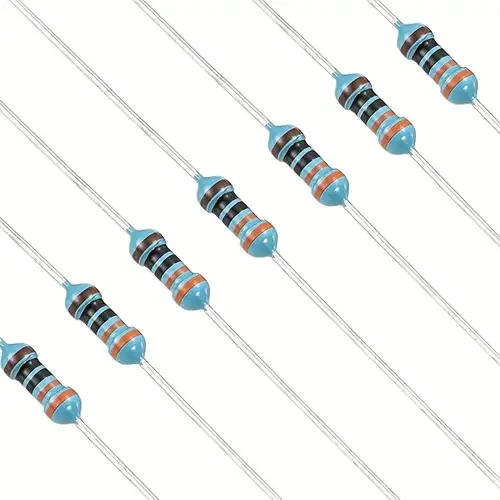
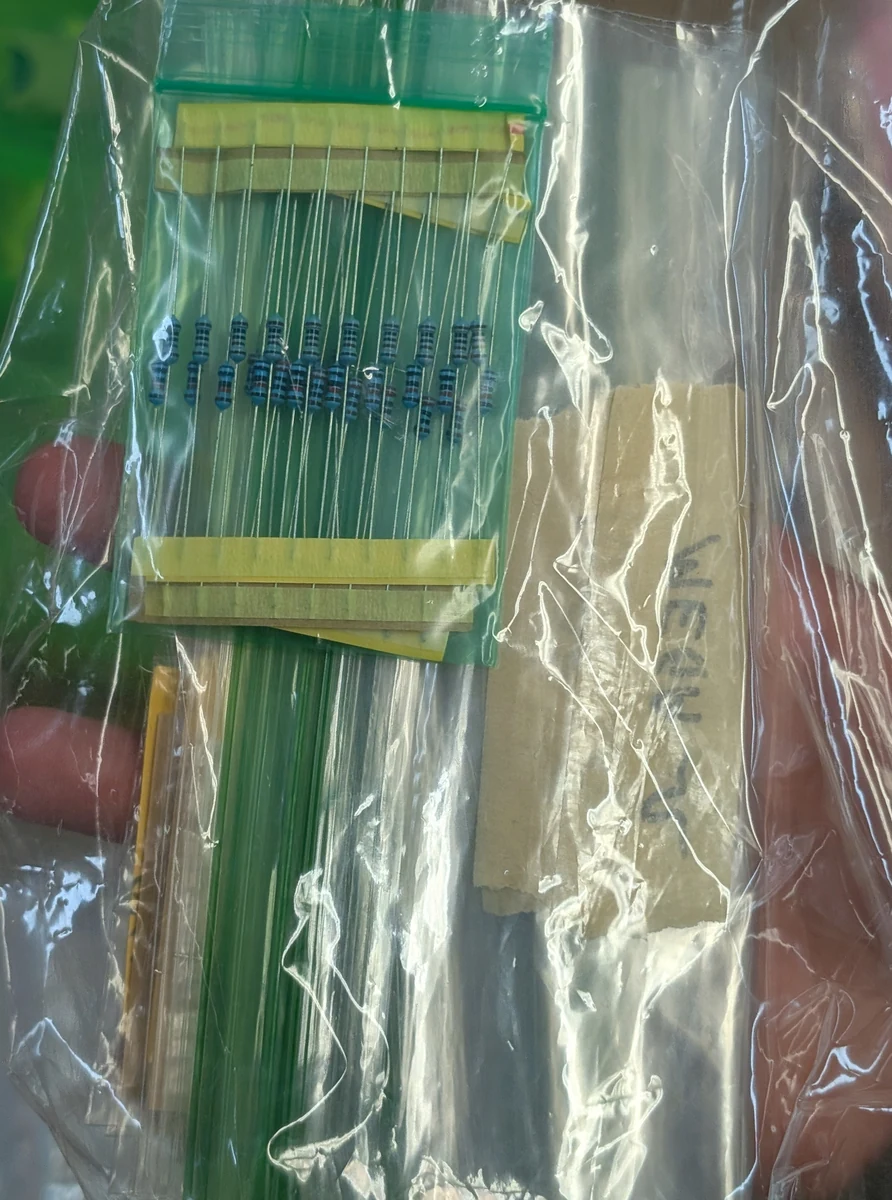
Small axial body with one wire at each end. Find the labeled value compartment and measure an isolated loose part with a meter; the shared inventory image is a form reference.

Also called: 330R

How to use it

Place it in series to limit current, or combine it with another resistance as a divider. For LED use, choose R = (supply voltage − LED forward voltage)/desired current. Check dissipation and GPIO current separately.

Know before using

Limits

  • Finite power dissipation; resistance varies with tolerance and temperature.
  • High resistance can increase noise and ADC source impedance.

Common mistakes

  • Selecting only the resistance while ignoring watts.
  • Measuring in circuit and mistaking parallel paths for the resistor value.

What can I build?

Browse all 7 relevant ideas →

Related owned hardware

Read the conditions before connecting parts. A relationship can involve a driver, controller or a redesigned circuit.

current limiting

Red LED

  • 330 Ω is an owned resistor candidate for conservative indicator-current calculations.

Connection conditions

  • Compute current from actual forward drop and supply; not every carrier needs an added resistor.

current limiting

Yellow LED

  • 330 Ω is an owned resistor candidate for conservative indicator-current calculations.

Connection conditions

  • Compute current from actual forward drop and supply; not every carrier needs an added resistor.

current limiting

Green LED

  • 330 Ω is an owned resistor candidate for conservative indicator-current calculations.
  • 330 Ω is a lower-current indication candidate than 220 Ω under the same voltage/drop.

Connection conditions

  • Compute current from actual forward drop and supply; not every carrier needs an added resistor.
  • Nominal value does not establish resistor watts/tolerance; check the complete circuit.

current limiting

Blue LED

  • 330 Ω is an owned resistor candidate for conservative indicator-current calculations.

Connection conditions

  • Compute current from actual forward drop and supply; not every carrier needs an added resistor.

current limiting

White LED

  • 330 Ω is an owned resistor candidate for conservative indicator-current calculations.

Connection conditions

  • Compute current from actual forward drop and supply; not every carrier needs an added resistor.

current limiting

Assorted LEDs

  • 330 Ω is an owned resistor candidate for conservative indicator-current calculations.

Connection conditions

  • Compute current from actual forward drop and supply; not every carrier needs an added resistor.

current limiting

Through-hole RGB LED

  • 330 Ω is an owned resistor candidate for conservative indicator-current calculations.

Connection conditions

  • Compute current from actual forward drop and supply; not every carrier needs an added resistor.

current limiting

Bicolor LED module

  • 330 Ω is an owned resistor candidate for conservative indicator-current calculations.

Connection conditions

  • Compute current from actual forward drop and supply; not every carrier needs an added resistor.

current limiting

Mini bicolor LED module

  • 330 Ω is an owned resistor candidate for conservative indicator-current calculations.

Connection conditions

  • Compute current from actual forward drop and supply; not every carrier needs an added resistor.

current limiting

Through-hole RGB LED module

  • 330 Ω is an owned resistor candidate for conservative indicator-current calculations.

Connection conditions

  • Compute current from actual forward drop and supply; not every carrier needs an added resistor.

current limiting

SMD RGB LED module

  • 330 Ω is an owned resistor candidate for conservative indicator-current calculations.

Connection conditions

  • Compute current from actual forward drop and supply; not every carrier needs an added resistor.

current limiting

Automatic multicolor flashing LED module

  • 330 Ω is an owned resistor candidate for conservative indicator-current calculations.

Connection conditions

  • Compute current from actual forward drop and supply; not every carrier needs an added resistor.

measurement

AstroAI digital multimeter

  • An isolated resistance measurement confirms the labeled nominal value before precision calculations.

Connection conditions

  • Parallel paths corrupt an in-circuit reading.

prototyping

830-point solderless breadboard

  • The axial leads fit a solderless divider/current-limit experiment on distinct contact strips.

Connection conditions

  • Check strip connectivity and keep resistor dissipation within actual rating.

Owned substitutions

220 Ω resistor

partial redesign

For an indicator circuit, the other value can set a different acceptable current after recalculation.

Required changes

  • Recalculate current and dissipation from actual supply and LED forward drop.
  • Brightness changes; the lower resistance can exceed LED/GPIO limits.
  • Not a precision divider/timing substitution.

Documentation

Inventory record and image evidence

Quantity: 10 · quantity confidence: high

Known countable purchase/BOM contributions. Each source line is a total; do not multiply by container count or add photo observations.

Ownership: source-backed club holding. Identity confidence: high.

Resistance value is established by source-specific purchase/BOM lines and labeled storage; image is a representative class illustration.

V1 establishes the catalog identity. Technical references explain the named device or component class; unverified carrier-specific ratings and pinouts are not asserted.

Source holdings

Parent kits

Original V3 image confidence: 90% · high. Representative axial resistor image is suitable for this source-grounded value; labeled storage/measuring establishes value, and the image need not encode exact color bands.

Original V3 image source: Supplied owned-kit resistor crop, accepted generic class image (owned kit reference). Images describe identity and form; they do not establish quantity.

Displayed image source: User-approved shared axial resistor form reference, reused from the resistor assortment at the user's explicit request.

User explicitly requested the existing approved generic resistor image for all resistor values. The group photograph is a component-form reference; displayed bands and item count do not establish this record's resistance, rating or inventory quantity.

User-supplied reference image; original rights retained.