advanced
Calibrate the existing PiCrawler before new gaits
Needs additional hardwareVerify the installed robot revision, neutral positions and joint offsets, then test one conservative gait.
Motors & Actuators
The PiCrawler assembly is a four-legged servo robot for learning gait sequencing, calibration and Raspberry Pi-driven motion control.
Only known source contributions are counted; this expected quantity is incomplete.
Servo controller; host software; revision-specific wiring
Turns coordinated joint positions into crawling motion. The mechanism combines servo limits, link lengths and body balance; useful motion depends on calibration and consistent power, not simply commanding all joints to the same angle.
Each leg’s linked joints place its foot through servo angles. A gait alternates support and swing phases so some feet stabilize the body while others move. The host computes motions and the controller distributes servo commands; internal servo feedback controls each joint, not necessarily whole-body position.
SunFounder crawler chassis with four articulated servo legs and control electronics. Match actual board/chassis revision and cable labels before loading a tutorial configuration.
Identify hardware revision, supply and controller, then follow the matching assembly/servo-zero and calibration instructions. Support the body off the ground for the first motion test, establish safe joint limits and use a flat clear surface. Start with slow example motion before changing gait geometry; do not assume the existing assembly is calibrated.
advanced
Verify the installed robot revision, neutral positions and joint offsets, then test one conservative gait.
Read the conditions before connecting parts. A relationship can involve a driver, controller or a redesigned circuit.
robotics host
assembly context · robotics learning
Quantity: uncertain · quantity confidence: unresolved
Known countable purchase/BOM contributions. Each source line is a total; do not multiply by container count or add photo observations.
Ownership: source-backed club holding. Identity confidence: confirmed.
Supported by source contribution; unresolved variant and source details remain on its holding.
V1 establishes the catalog identity. Technical references explain the named device or component class; unverified carrier-specific ratings and pinouts are not asserted.
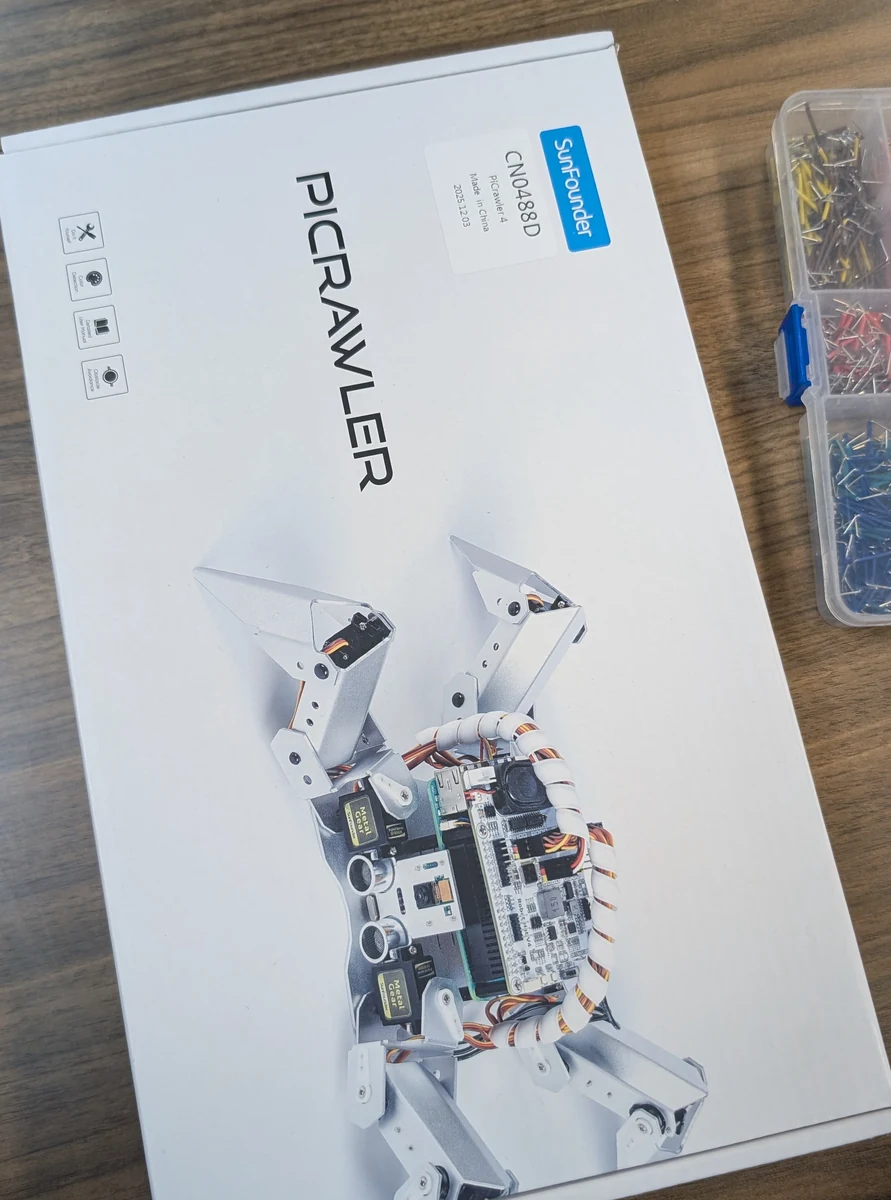
Image confidence: 85% · high. Actual owned PiCrawler box depicts the robot; this is package reference artwork, not proof of assembly.
Image source: Engineering Club actual item (physical photo). Images describe identity and form; they do not establish quantity.