advanced
Calibrate the existing PiCrawler before new gaits
Needs additional hardwareVerify the installed robot revision, neutral positions and joint offsets, then test one conservative gait.
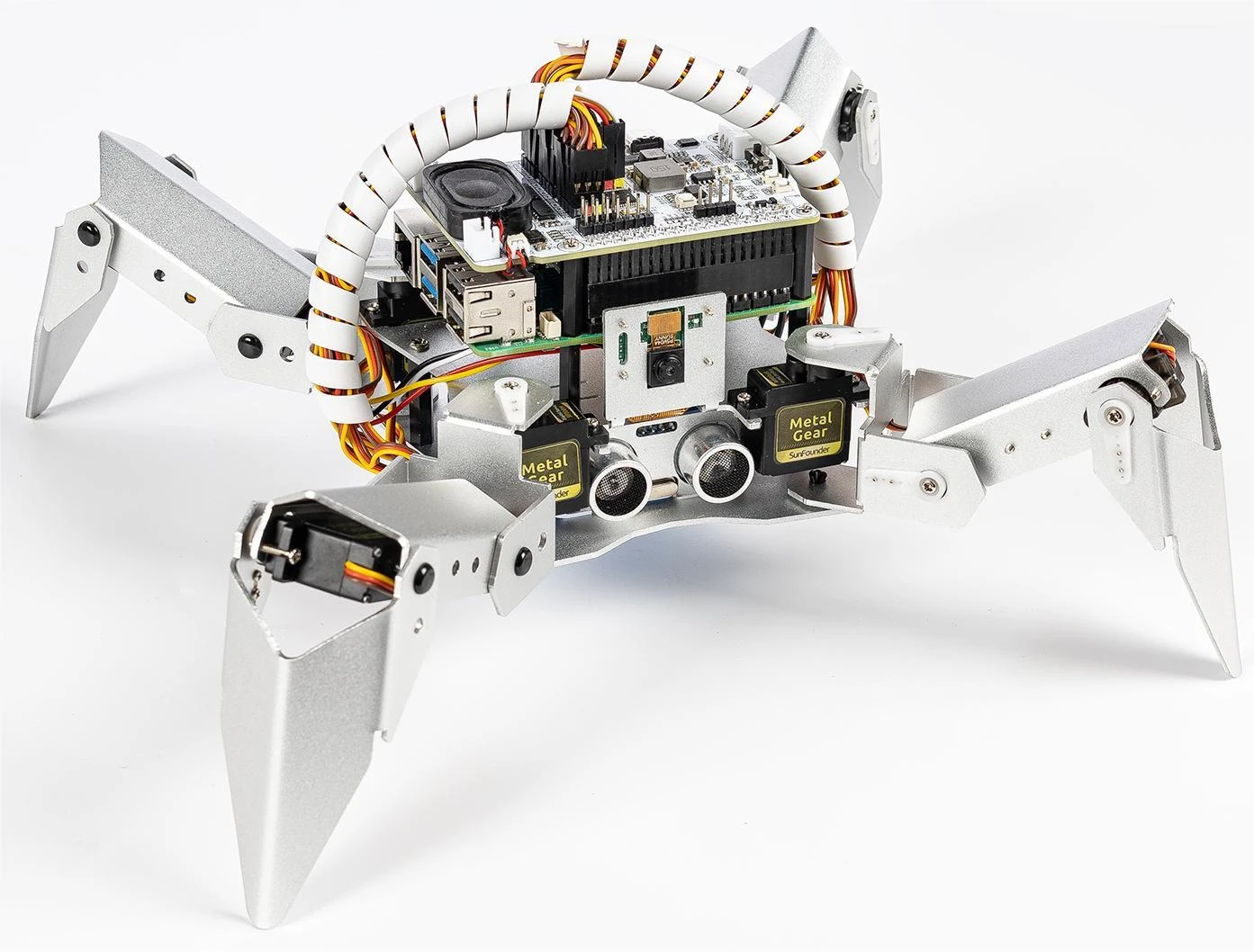
Robotics / Parent kit
SunFounder PiCrawler combines a Raspberry Pi host, articulated mechanical parts and servo control for learning walking-robot assembly and motion programming.
Leg mechanism, servos, controller hardware and revision-specific robot accessories provide a sequence of tangible experiments. Set up the host and controller, zero servos during assembly, calibrate joints, then explore slow gaits and motion sequences. The educational value comes from measuring and explaining each circuit rather than just replaying supplied code.
Software converts a desired body or foot movement into joint targets; the servo controller distributes pulse commands and motor power. Link lengths, neutral horn placement and calibration offsets determine the physical result, so copying a gait alone cannot correct a misassembled leg.
Look for SunFounder PiCrawler packaging or its low articulated crawler frame and servo-driven legs. Match controller and mechanical revision to the official assembly instructions.
Set up the host and controller, zero servos during assembly, calibrate joints, then explore slow gaits and motion sequences. Before each lesson, use the individual component record to check power, signal levels and driver needs. Keep the frozen source holding/BOM as the ownership reference and use current documentation only for technical learning. Exact installed revision and software compatibility must be checked. This parent kit and robot assembly are distinct frozen records; no servo counts or BOM expansion is performed.
These links follow the frozen source holding lines. Kit and component quantities describe different units; do not add them as a stock total.
advanced
Verify the installed robot revision, neutral positions and joint offsets, then test one conservative gait.
club-wide demonstrator; not a claim that every required component belongs to this kit
Read the conditions before connecting parts. A relationship can involve a driver, controller or a redesigned circuit.
assembly context · robotics learning
Quantity: 1 · quantity confidence: confirmed
Purchased kit-container count; excluded from component-unit aggregate.
Ownership: source-backed club holding. Identity confidence: probable.
Legacy photographed or listed component class; exact model may be unresolved.
Parent identity and contributions remain frozen. Technical learning descriptions do not assert a new BOM or complete current physical stock.
Original V3 image confidence: 82% · high. Physical club photograph supports the visible component class; full scene retained as evidence.
Original V3 image source: Engineering Club photographs (physical photo). Images describe identity and form; they do not establish quantity.
Displayed image source: User-supplied sunfounder-picrawler-kit reference image attached in chat.
User-selected assembled SunFounder crawler reference replaces the kit packaging image. Full chassis, articulated legs, electronics, cables and attachments retained. It represents the assembled kit and does not establish actual club assembly state, contents or controller revision.
User-supplied reference image; original rights retained.