Site Guide

Find your way around the Engineering Club.

Know what you need? Search for a component, concept or project.

Around the site

Start

Labs

TestingExperimental

Build

Club

LearnExperimental

Go a little deeper

Entry points to larger collections. Use Search for individual records.

Learning paths & reference

Inside PiCrawlerExperimental

Inside Inventory

← Club inventory
RC522 RFID reader module

Communication

RC522 RFID reader module

An RC522-compatible reader uses 13.56 MHz near-field coupling to communicate with supported passive RFID cards and fobs.

Owned by clubQuantity: 2

SPI · SPI typical carrier; chip also supports other configured interfaces · 13.56 MHz near-field tag link

What it does

Reads identifiers and, where tag type/security permits, exchanges memory data with nearby tags. It is useful for attendance or access-control prototypes, but reading a UID alone is not secure authentication. It is not a reader for arbitrary 125 kHz tags or long-range UHF tags.

Useful specifications

RF carrier
13.56 MHz
Supported class
ISO/IEC 14443A, MIFARE/NTAG support as specified
Reference chip supply
2.5–3.3 V nominal family; check datasheet conditions
Carrier logic
Treat as 3.3 V unless exact level shifting is documented
Carrier host interface
Typically SPI; actual strapping/pinout must be checked
How it works

The PCB coil produces an alternating magnetic field that powers a passive tag by inductive coupling. The reader modulates the field to send data; the tag changes its electrical load to return a response. The MFRC522 handles RF framing and CRC while the host manages tag commands and permissions.

Recognize the part

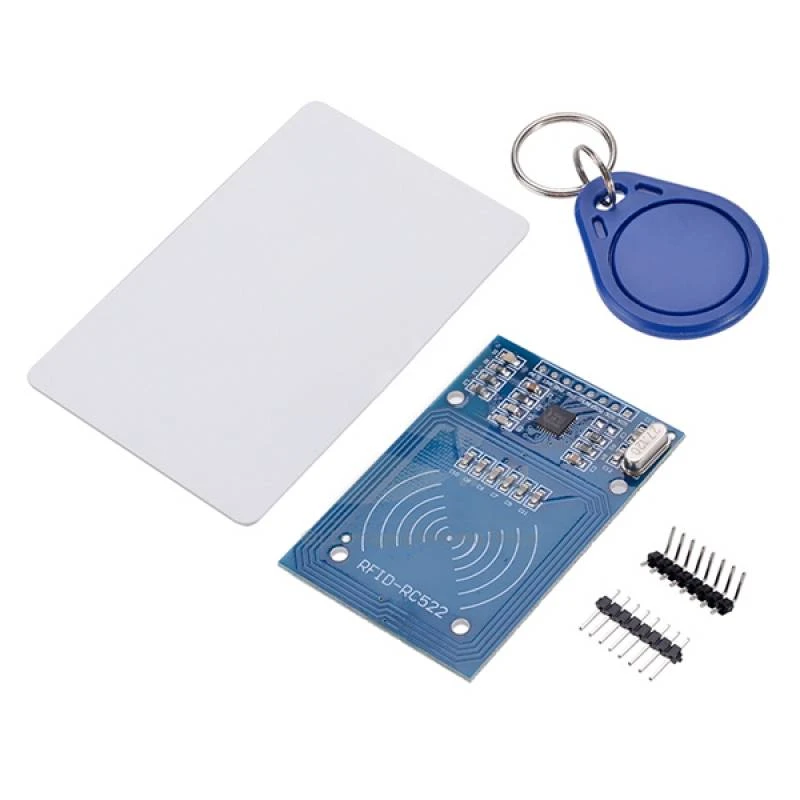
Flat carrier with a large rectangular printed antenna loop, MFRC522/RC522 marking and a signal header. Match input/output pin legends to the configured host interface.

Also called: MFRC522 reader, RC522, RFID Module, rc522 rfid module

How to use it

Use the actual carrier pinout and a 3.3 V power/logic domain. Most hobby carriers are configured for SPI; a header marked SDA can mean SPI chip select on that carrier, not I²C data. Connect clock, MOSI, MISO, select and reset as documented, with level shifting from a 5 V host. Test one known compatible tag close and parallel to the antenna. Identify tag technology before attempting writes or authentication, and avoid changing access-control bits casually.

Know before using

Limits

  • Short range, tag-type restrictions and antenna detuning near metal.
  • UID alone can be copied/replayed and is not a security design.

Common mistakes

  • Feeding the common carrier with 5 V or 5 V SPI signals.
  • Treating its SDA label as proof of I²C.
  • Expecting all RFID frequencies/protocols to work.

Care and safety

  • Protect 3.3 V power and logic; check tag permissions before writes.

What you need with it

required

Raspberry Pi Pico

A compatible host runs tag commands over SPI.

  • Tag protocol and supply/logic must match.
Owned type; verify quantity, rating and fit for this use.

What can I build?

Related owned hardware

Read the conditions before connecting parts. A relationship can involve a driver, controller or a redesigned circuit.

spi reader

Raspberry Pi Pico

  • Pico’s 3.3 V SPI domain is a natural host for the usual 3.3 V RC522 carrier.
  • RC522 supplies a tag-reader peripheral for a Pico application.

Connection conditions

  • Verify carrier labels; SDA may be SPI select. Match the tag technology.
  • Tag protocol and supply/logic must match.

spi reader

Arduino Uno R3

  • An Uno can run an RC522 library when its 5 V outputs are properly translated.

Connection conditions

  • Add suitable SPI level translation for 5 V host outputs; do not assume a 3.3 V regulator shifts signals.

rfid tag

RFID card tag

  • Test this tag against the reader’s supported frequency/protocol and compare responses.
  • This owned tag is a concrete test target for reader initialization and tag commands.

Connection conditions

  • Do not assume every tag is compatible; UID alone is not secure authentication.

rfid tag

RFID keyfob tag

  • Test this tag against the reader’s supported frequency/protocol and compare responses.
  • This owned tag is a concrete test target for reader initialization and tag commands.

Connection conditions

  • Do not assume every tag is compatible; UID alone is not secure authentication.

If you outgrow it

Researched external products, separate from club inventory. Price and availability are not promised.

Adafruit

PN532 NFC/RFID breakout v1.6, product 364

Not owned by club

The reader application needs a supported NFC workflow or host interface beyond its existing RC522 SPI implementation.

What improves

  • Offers UART/I²C/SPI host-interface choices and an NFC-oriented reader/software path.
  • Supports different NFC workflows when the exact tag protocol and library features match.

The reader application needs a supported NFC workflow or host interface beyond its existing RC522 SPI implementation. Choose this path only when the stated improvement is a requirement.

Tradeoffs

  • Still a 13.56 MHz ecosystem; not an arbitrary RFID-frequency reader.
  • Tag UID observation is not secure access authentication; library/protocol coverage must be checked.

Additional hardware

  • Supported tags and NFC library, chosen host-interface wiring and level-compatible supply/signals
Migration steps
  • Review the exact product documentation and chosen carrier before purchase.
  • Rework connections, firmware/library configuration, power and mechanics as required by this path.
  • Validate the new subsystem against the project measurement or timing requirement.

Official product / documentation ↗

Documentation

Inventory record and image evidence

Quantity: 2 · quantity confidence: high

Known countable purchase/BOM contributions. Each source line is a total; do not multiply by container count or add photo observations.

Ownership: source-backed club holding. Identity confidence: high.

Identity follows exact kit sheet/BOM; expected quantity is not a physical stocktake.

V1 establishes the catalog identity. Technical references explain the named device or component class; unverified carrier-specific ratings and pinouts are not asserted.

Source holdings

Parent kits

Original V3 image confidence: 90% · high. Component crop tied to an owned kit and its source mapping; selected by form rather than filename alone.

Original V3 image source: ELEGOO Mega reference (owned kit reference). Images describe identity and form; they do not establish quantity.

Displayed image source: User-supplied RC522 RFID reader module reference photograph.

User-selected unobscured RC522 carrier reference; card, keyfob and loose headers are pictured accessories and do not establish kit contents or quantities.

User-supplied reference image; original rights retained.