intermediate
Inspect owned RFID tags without writing access bits
Core electronics availableRead identification and protocol responses from the owned card and keyfob with a 3.3 V host.
Communication
A passive RFID card stores an identifier and tag-dependent data for contactless reader experiments.
Passive contactless RF
The card is the carried token, not the reader. It returns information when energized by a compatible field; memory size and security features depend on the embedded chip, which is not established by the outer casing.
A hidden antenna couples energy from the reader into a tag IC. The chip sends data back by modulating its load; a passive tag needs no user-replaceable battery. Frequency/protocol compatibility is necessary even when two tags look alike.
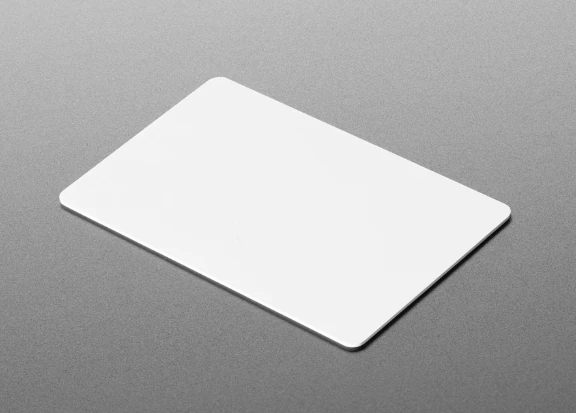
Flat white plastic card without exposed contacts. Neither enclosure identifies the silicon.
Also called: RFID White Card
Read with a compatible kit reader, record the detected tag technology and UID, then use only documented memory operations. Keep away from metal during initial tests. Do not treat UID comparison as a secure lock design.
intermediate
Read identification and protocol responses from the owned card and keyfob with a 3.3 V host.
Read the conditions before connecting parts. A relationship can involve a driver, controller or a redesigned circuit.
rfid tag
Quantity: 2 · quantity confidence: high
Known countable purchase/BOM contributions. Each source line is a total; do not multiply by container count or add photo observations.
Ownership: source-backed club holding. Identity confidence: high.
Identity follows exact kit sheet/BOM; expected quantity is not a physical stocktake.
V1 establishes the catalog identity. Technical references explain the named device or component class; unverified carrier-specific ratings and pinouts are not asserted.
Original V3 image confidence: 90% · high. Component crop tied to an owned kit and its source mapping; selected by form rather than filename alone.
Original V3 image source: Keyestudio KS3020 (owned kit reference). Images describe identity and form; they do not establish quantity.
Displayed image source: User-supplied RFID card reference image attached in chat.
Plain white contactless-card form matches the canonical RFID card tag. This user-supplied reference does not establish chip identity, protocol, frequency, memory size or the exact owned card.
User-supplied reference image; original rights retained.