Arduino Uno R3
required for digital readout
An ADC-equipped controller converts the signal voltage into readings.
- For Pi 4/5 use a separately identified ADC; their GPIO headers have no general-purpose analog input.
Sensors
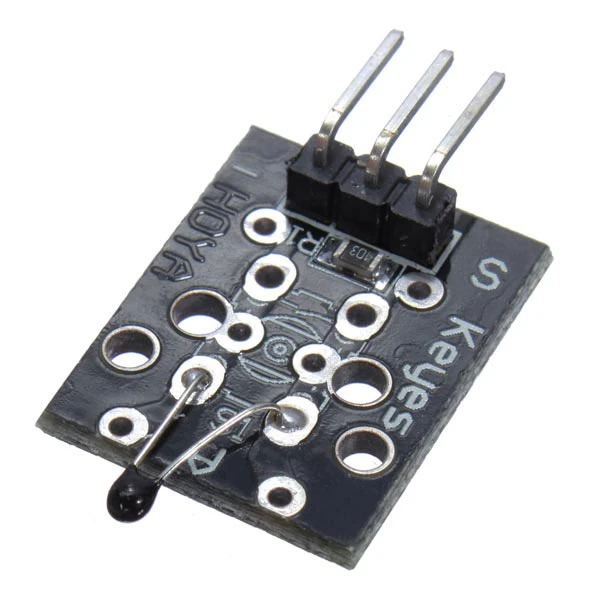
An analog thermistor carrier converts temperature changes into resistance changes for divider-based measurement.
Resistance/divider analog signal
Supports contact temperature trends and threshold experiments. Without nominal resistance and a curve, it gives temperature trends rather than a justified Celsius reading.
In a typical NTC ceramic semiconductor, warmer material has more available charge carriers, so resistance decreases nonlinearly. A fixed resistor forms a divider that turns resistance into voltage. Confirm NTC/PTC behavior rather than transferring another thermistor’s curve.
Small metal-oxide sensing body with electrodes; coating protects the bead but affects response time.
Small PCB with two-lead bead or thermistor at the edge. A bare bead can look like a ceramic capacitor; resistance and response to gentle warming distinguish them.
Also called: Analog Temp
Check carrier analog-output pin and divider/pull-up rail. Use an ADC-safe rail and calculate resistance from the divider orientation. Convert to temperature only with the actual curve or calibrated points; use low sensing current to reduce self-heating.
required for digital readout
An ADC-equipped controller converts the signal voltage into readings.
Read the conditions before connecting parts. A relationship can involve a driver, controller or a redesigned circuit.
analog measurement
analog measurement
measurement
Temperature-measurement strategy; humidity and calibration requirements can rule out alternatives.
Use DHT11 only when humidity matters and modest accuracy is sufficient. DS18B20 provides addressed digital temperature. LM35 produces a temperature-proportional voltage with supply constraints. Thermistors are useful for resistance/calibration lessons; nominal resistance alone does not justify Celsius values.
Researched external products, separate from club inventory. Price and availability are not promised.
Texas Instruments
A calibrated local-temperature requirement exceeds an uncharacterized analog conversion or coarse sensor subsystem.
A calibrated local-temperature requirement exceeds an uncharacterized analog conversion or coarse sensor subsystem. Choose this path only when the stated improvement is a requirement.
Quantity: 1 · quantity confidence: probable
Known countable purchase/BOM contributions. Each source line is a total; do not multiply by container count or add photo observations.
Ownership: source-backed club holding. Identity confidence: probable.
Supported by source contribution; unresolved variant and source details remain on its holding.
V1 establishes the catalog identity. Technical references explain the named device or component class; unverified carrier-specific ratings and pinouts are not asserted.
Original V3 image confidence: 75% · probable. Seller reference matches the component class; exact carrier revision is not established by this artwork.
Original V3 image source: 45-in-1 seller sheet (seller reference). Images describe identity and form; they do not establish quantity.
Displayed image source: User-supplied Analog thermistor temperature module reference photograph.
Analog thermistor carrier reference; the thermistor value, calibration and pinout remain source-based.
User-supplied reference image; original rights retained.