Site Guide

Find your way around the Engineering Club.

Know what you need? Search for a component, concept or project.

Around the site

Start

Labs

TestingExperimental

Build

Club

LearnExperimental

Go a little deeper

Entry points to larger collections. Use Search for individual records.

Learning paths & reference

Inside PiCrawlerExperimental

Inside Inventory

← Club inventory
DHT11 temperature and humidity sensor, bare part

Sensors

DHT11 temperature and humidity sensor, bare part

DHT11 reports air temperature and relative humidity over a timing-sensitive single-data-wire protocol; it suits coarse indoor monitoring.

Owned by clubQuantity: 1

DHT pulse-timed data; power/ground

What it does

Returns two environmental measurements as a digital message rather than exposing a raw analog voltage. Relative humidity describes moisture relative to saturation at the local temperature; breathing on the package tests response but is not calibration.

Useful specifications

Typical supply
3–5 V class; confirm actual version
Legacy DHT11 nominal range
20–80 %RH; 0–50 °C
Legacy nominal accuracy
About ±5 %RH and ±2 °C
Read interval
Use at least 1 s; slower polling is appropriate
How it works

A humidity-sensitive resistive element and an internal temperature sensor feed conversion and calibration electronics. A request from the host starts a pulse-timed message containing humidity, temperature and a checksum. This protocol is distinct from Dallas 1-Wire.

Vented housing lets air reach the sensing elements; a carrier changes wiring convenience, not the measurement principle.

Recognize the part

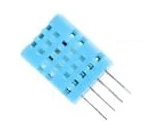
Blue vented four-pin rectangular package without a PCB; one pin is unused in the standard DHT11 package.

Also called: Temperature and Humidity Sensor, temperature and humidity sensor

How to use it

Use a DHT11-specific library and allow stabilization after power-up. Add the data pull-up required by the sensor and verify package orientation. For a 5 V-powered carrier, inspect the pull-up rail before using 3.3 V GPIO. Read slowly and reject checksum errors.

Know before using

Limits

  • Coarse resolution, limited range and slow response.
  • Condensation and contamination impair humidity readings.
  • Heat from a nearby board biases air temperature.

Common mistakes

  • Using a DHT22 driver setting.
  • Polling as fast as an ADC.
  • Treating a valid checksum as proof of accuracy.

Care and safety

  • Avoid wetting the sensor; verify data pull-up voltage.

What you need with it

required

Arduino Uno R3

A controller issues the start request, decodes pulses and validates the checksum.

  • Other owned controllers can fill this role after software/voltage checks.
Owned type; verify quantity, rating and fit for this use.

10 kΩ resistor

A data pull-up gives the bare sensor a defined high state; 10 kΩ is an owned candidate.

  • Confirm the sensor/library-required range and wiring capacitance; a carrier may already contain a pull-up.
Owned type; verify quantity, rating and fit for this use.

What can I build?

beginner

Bring up the bare DHT11 interface

Core electronics available

Compare package wiring and external pull-up requirements with the owned carrier’s easier connector.

Related owned hardware

Read the conditions before connecting parts. A relationship can involve a driver, controller or a redesigned circuit.

controller

Arduino Uno R3

  • Uno runs a DHT11 pulse decoder and can report checksum-checked temperature/humidity.
  • DHT11 gives an Uno a slow environmental measurement without an external ADC.

Connection conditions

  • Allow at least one second between reads; confirm supply and data pull-up voltage.
  • Other owned controllers can fill this role after software/voltage checks.

wireless controller

Raspberry Pi Pico 2 W

  • Pico 2 W can publish slow humidity readings without leaving a computer connected.

Connection conditions

  • Verify actual output/pull-up voltage before connecting to 3.3 V GPIO; use suitable level translation where required.
  • Use a library that explicitly supports DHT11, not DHT22 settings.

local display

LCD1602 16×2 Character Display with I²C Backpack

  • 16×2 text is sufficient for temperature, relative humidity and a stale/error marker.

Connection conditions

  • Check the carrier supply, address and pull-up rail. Use one compatible pull-up network for the bus and avoid pulling 3.3 V GPIO to 5 V.
  • Route measurements through a controller; refresh no faster than valid sensor updates.

support hardware

10 kΩ resistor

  • A data pull-up gives the bare sensor a defined high state; 10 kΩ is an owned candidate.

Connection conditions

  • Confirm the sensor/library-required range and wiring capacitance; a carrier may already contain a pull-up.

When would I use each?

Temperature Sensors

Temperature-measurement strategy; humidity and calibration requirements can rule out alternatives.

Use DHT11 only when humidity matters and modest accuracy is sufficient. DS18B20 provides addressed digital temperature. LM35 produces a temperature-proportional voltage with supply constraints. Thermistors are useful for resistance/calibration lessons; nominal resistance alone does not justify Celsius values.

Owned substitutions

DHT11 humidity-temperature module

partial redesign

The bare/carrier pair provides the same underlying component class when the fitted circuitry is identified.

Required changes

  • Rewire package/header pins and add or account for carrier bias/driver/suppression components.
  • Check supply, output polarity and signal voltage.
  • Carrier circuitry is not assumed from board shape.
  • The carrier does not inherently improve the sensing die or contact rating.

If you outgrow it

Researched external products, separate from club inventory. Price and availability are not promised.

Sensirion

SHT45

Not owned by club

DHT11’s coarse and restricted sensing performance limits an environmental instrument that needs documented accuracy.

What improves

  • Provides substantially tighter documented humidity/temperature measurement than the DHT11 class.
  • Typical ±1 %RH and ±0.1 °C apply under the specified conditions; I²C replaces DHT pulse timing.

DHT11’s coarse and restricted sensing performance limits an environmental instrument that needs documented accuracy. Choose this path only when the stated improvement is a requirement.

Tradeoffs

  • Raw sensor supply is 1.08–3.6 V; a carrier regulator does not automatically make signal pins 5 V tolerant.
  • Condensation, heating and placement still affect an ambient measurement.

Additional hardware

  • Suitable SHT45 breakout/carrier, compatible I²C pull-ups and host library; enclosure/airflow suited to the measurement
Migration steps
  • Review the exact product documentation and chosen carrier before purchase.
  • Rework connections, firmware/library configuration, power and mechanics as required by this path.
  • Validate the new subsystem against the project measurement or timing requirement.

Official product / documentation ↗

Bosch Sensortec

BME280

Not owned by club

The environmental project needs pressure/altitude-related measurements that DHT11 cannot provide.

What improves

  • Adds barometric pressure to a humidity/temperature measurement subsystem.
  • Digital I²C/SPI interfaces allow documented compensation and pressure-based experiments.

The environmental project needs pressure/altitude-related measurements that DHT11 cannot provide. Choose this path only when the stated improvement is a requirement.

Tradeoffs

  • Pressure is the distinguishing benefit; it is not automatically the highest-accuracy humidity choice.
  • Board heat and enclosure placement affect temperature; raw device power/signals are low voltage.

Additional hardware

  • Verified BME280 breakout rather than the humidity-free BMP280; compatible pull-ups, library and enclosure
Migration steps
  • Review the exact product documentation and chosen carrier before purchase.
  • Rework connections, firmware/library configuration, power and mechanics as required by this path.
  • Validate the new subsystem against the project measurement or timing requirement.

Official product / documentation ↗

Documentation

Inventory record and image evidence

Quantity: 1 · quantity confidence: high

Known countable purchase/BOM contributions. Each source line is a total; do not multiply by container count or add photo observations.

Ownership: source-backed club holding. Identity confidence: high.

Identity follows exact kit sheet/BOM; expected quantity is not a physical stocktake.

V1 establishes the catalog identity. Technical references explain the named device or component class; unverified carrier-specific ratings and pinouts are not asserted.

Source holdings

Parent kits

Original V3 image confidence: 95% · high. Visible bare/carrier/trimmer form checked against canonical identity; source-kit crop retained at native resolution.

Original V3 image source: Freenove FNK0020 older sheet (owned kit reference). Images describe identity and form; they do not establish quantity.

Displayed image source: Freenove FNK0020 older sheet; user-approved V2 image cleanup.

User explicitly authorized integration of approved entries from the supplied V2 decisions export. Exact reviewed candidate bytes retained; original inventory identity, confidence and hardware facts remain unchanged.

Original reference image rights retained; cleanup does not change attribution or license.