beginner
Measure indicator current at two resistor values
Core electronics availableCompare predicted and measured LED current while learning the difference between voltage and current measurement.
Kits / Parent kit
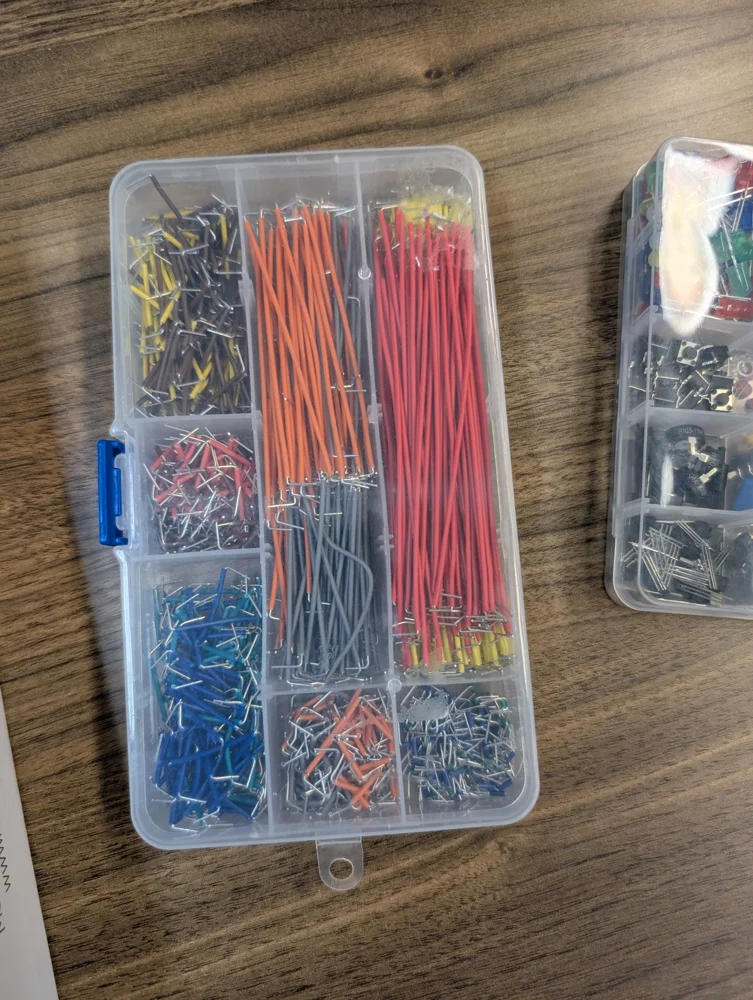
A breadboard and jumper-wire set provides reusable connections for low-current prototype circuits without soldering.
Breadboard contact strips and removable wire connections provide a sequence of tangible experiments. Map internal breadboard connectivity first, build a simple measured circuit, then reuse the wiring platform for more complex circuits. The educational value comes from measuring and explaining each circuit rather than just replaying supplied code.
Spring contacts join small groups of holes under the breadboard surface. Jumper conductors connect those groups into the intended circuit; the center gap separates IC pin rows. Power rails may be split, so apparent alignment does not guarantee continuity.
A perforated solderless board with labeled terminal rows and power rails, accompanied by removable jumper leads. Inspect the underside/model and wire ends to distinguish it from soldered perfboard or a passive cable assortment.
Map internal breadboard connectivity first, build a simple measured circuit, then reuse the wiring platform for more complex circuits. Before each lesson, use the individual component record to check power, signal levels and driver needs. Keep the frozen source holding/BOM as the ownership reference and use current documentation only for technical learning. This parent set is a holding; contact holes, individual wires and the set container are different countable concepts already resolved in V1.
These links follow the frozen source holding lines. Kit and component quantities describe different units; do not add them as a stock total.
beginner
Compare predicted and measured LED current while learning the difference between voltage and current measurement.
beginner
Count deliberate button presses once each and report the count over USB serial.
beginner
Sweep a 10 kΩ wiper and compare meter voltage with quantized Uno ADC codes.
club-wide demonstrator; not a claim that every required component belongs to this kit
club-wide demonstrator; not a claim that every required component belongs to this kit
club-wide demonstrator; not a claim that every required component belongs to this kit
Read the conditions before connecting parts. A relationship can involve a driver, controller or a redesigned circuit.
kit learning anchor
Quantity: 1 · quantity confidence: confirmed
Purchased kit-container count; excluded from component-unit aggregate.
Ownership: source-backed club holding. Identity confidence: probable.
Legacy photographed or listed component class; exact model may be unresolved.
Parent identity and contributions remain frozen. Technical learning descriptions do not assert a new BOM or complete current physical stock.
Image confidence: 82% · high. Physical club photograph supports the visible component class; full scene retained as evidence.
Image source: Engineering Club photographs (physical photo). Images describe identity and form; they do not establish quantity.